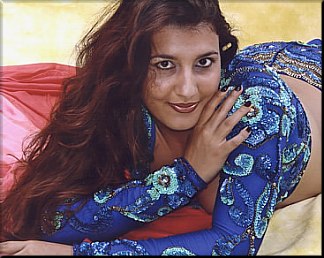
Interview with Maya Gaorry of Italy Talks about Size, Fat, and American dancers July 5, 2005 by Lucy Lipschitz Maya Gaorry is a dancer and a teacher of Middle-Eastern dance at an international level. She has a degree in psychology and has been devoting herself to the study and practice of Oriental Dance for many years. She is of Italo-Brazilian origin and lives in Trieste, where she experienced working with belly dance in the field of mental health at the ‘Centro Donna di Salute Mentale’ (1999). She is the president of Racks al Shark, an association for the promotion of Middle-Eastern dance; she runs her own school and is art-director for the Shams Middle-Eastern dance company. She was guest dancer during the Belly Dance Superstars’ show in Milan. She has been running workshops in many Italian cities, as well as in Slovenia, Croatia, Brazil, and Portugal. This interview took place over the course of three evenings, while Maya stayed with Lucy and family. Maya sponsored Lucy in a fusion workshop in Trieste, Italy, in March, 2004 Lucy: Maya, what made you decide to bring SAMBALADY to the United States? Maya: First. I want to explain why I made this new style. I’m from Brazil, and I always thought to do something with the Samba. I looked and looked and finally found some good music, called “ Rio de JaCairo”, which combines salsa with Arabic percussion. So I created a choreography for my students, and am teaching this workshop throughout Italy. At the Verona Festival (June), I performed it, and had great success. I decided to bring it to the US, because in America, people like fusion, and this way, I can teach both styles that I love: Samba and Oriental Dance. I have also found new ways to make hip movements in this dance. Lucy: How has it been to meet US dancers? Maya: I feel the girls are open and outgoing, gentle people. They want to have fun in the United States, everyone seems to be happy a lot. From some of the Americans, there is also something else—very kind, but with a certain wall that a person can not get past. (She makes a WHOMP sound with her hands.) Americans are very “giving”, but some of them seem to have limits to how much they will “give”. Lucy: As you have traveled throughout the US and have met many different types of Americans, are the dancers more or less open to you? Maya: I would definitely say the dancers are the most open. Lucy: How did you meet Amani of Lebanon? Maya: I took a trip to Lebanon to study the culture and the dance There were not many really good dancers there at the time. I contacted Amani for some private lessons, and we just became good friends. I spent Christmas 2003 with her at her home.We have a good relationship, and Amani is a diva in a good way—very kind and classy. She is nice to everyone, and has a VERY good heart. She says she prefers my Egyptian style to actual Egyptian dancers! Lucy: Any plans for the future in bringing US, European, and Brazilian dancers to come together? . Maya: (She seems stunned at this question and laughs.) Oh, Lucy, I have only thought about it, but not seriously. Whenever I think about sponsoring a workshop, I think of the cost first, and I know how impossible and expensive it would be to try to bring dancers from Brazil and Italy to the US; or Italian and US dancers to Brazil; it would just be so expensive for the participants. But I would love to do it someday. I just don’t think many people could afford such a trip. Lucy: Okay, now, here it comes.. the BIG question from the BIG dialog you and I discussed last night: How was it being in the BDSS in Milano, AND do you think this dance is changing because of it? Maya:(Very hesitant, a bit reluctant to answer.) The dancers in the show are wonderful. So kind, so good; I knew Dondi from before, and she suggested me to Miles Copeland. His assistant then wrote me - I had never heard of them [BDSS] before. Anyway, his secretary set it up for me to perform, and there I was; I took a train from Trieste. The dancers were so welcoming to me. I had a 3 minute routine I performed. They were very supportive of me. Now about changing this dance? I don’t know if it will help or not. On one hand, I think it will be bad. I think there will be a small problem of people thinking that all belly dancers MUST be thin to perform or succeed in this dance, and that people will think that belly dance is just this [one way]. He [Copeland] is repeating what the media wants: he chooses young, thin girls for the shows. But there is a big interest in the shows, at least among the dancers. I have not seen so much interest from just the regular people. But the Europeans like the tattoos, the dreadlocks, the tribal fusion very much - it is so different! Now, on the other hand, this show will be good for everyone in belly dance, because Oriental Dance is becoming more popular, and not just from this show. It is coming from many teachers like me, who teach in the cities and towns, and people go to class week after week. Lucy: Have you heard the stereotypes that belly dancers are fat? I had never heard of this; in the US, the stereotype has been that all belly dancers are supposed to be THIN. Maya: Well, in Lebanon, they want thin dancers. In Europe, Egypt, and Brazil, fat dancers were preferred, but now, it is slowly changing where the preference is for the dancer to be thin. And our fight is to make ALL women know she can be fat, thin, old or young to do this dance. Now, on the other hand, this show will be good for everyone in belly dance, because Oriental Dance is becoming more popular, and not just from this show. It is coming from many teachers like me, who teach in the cities and towns, and people go to class week after week. In BDSS, I felt that the dancers lacked emotion; but I think they were maybe tired. (It seemed to me that they were made to rush all the time). They are VERY strong dancers, a bit masculine. I think American dancers ARE very strong, they dance like POW!! POW!! POW!!. Where Egyptian style is very soft and feminine. I think it is good when a dancer can bring both feminine and masculine styles in.
Maya: IF you make a fist, and go POW! It is a masculine move, no matter what! And American dancers do a lot of TA DA! TA DA!!! (acting out some very sharp, staccato moves). And that is masculine. When you watch Egyptian dancers, they move very soft and feminine. This is also the same if the movement is strong. Saidi is masculine, very sharp and hard. I like American dancing a lot; the dancers are very strong out here. And they love to try out new things. The big problem is that just doing fusion, they will forget where Oriental Dance comes from. It is an ART form, and our work is to reflect the culture. First, we must teach the folkloric aspect, then Oriental. It will be bad if we just start teaching fusion right away. The history of this dance will be lost. The student won’t know the roots of this dance. Some fusion can be good, other times it can be used as an excuse for bad dancing. (A discussion ensues about whether new students will eventually want to learn the history of this dance if they start right into fusion styles). I think that teachers like you and me can fight against the stereotypes about thin, young dancers, and we can show that this dance is for all women. Lucy: Maya, we should define what “fat” means to you. Maya: I prefer not to have a definition of “fat” because when women dance, the dance “covers” the body. I really don’t notice people who are “fat” while dancing. I don’t want to negate the health problems of REALLY fat. I think people have to take care of themselves for health; even fat dancers, sure. However, this should not stop a woman from dancing; dance helps, right? This dance is for everybody. The problem is people giving more value to the body than to the dance's technique and quality. Before there was no rule on how big dancers should be, and now it’s changing. Changing everywhere. Lucy: Who makes the rules? Who says we must look a certain way? Maya: The society, The media, the bosses of everything: shows, clubs, restaurants, wherever we dance. It is important that dancers give value to the dance, not just how they look. The most important is the audience, who is US. Lucy: Many American dancers want to perform or teach in Europe, what advice do you have for them? Especially if they want to come to Italy to perform? Maya: They must show their work with a video, not just a website, because everyone has a website these days. Websites are not enough anymore. Maybe if they just go to Europe to dance, to learn. People need to know who you are first; then, if people like you, they will want you to return to do workshops and shows, like you did. Lucy: Many American dancers strive for a certain type of philosophy in this dance, i.e. one of empowerment of the feminine body, breaking stereotypes of beauty, and having a “dance sisterhood” with each other. How do Italian dancers look at this dance? Maya: Well, we have a few who are spiritual, who do Goddess dancing, but not too many. Lucy: In this case, I don’t mean Goddessy... more like a philosophy or an approach.. For instance, why do Italian women take belly dance lessons? Maya: They are attracted to it, but not sure why. For many, they are just brand new. I try to teach the history of this dance, and to educate them that this dance is not seductive or erotic, but an art form. I believe this dance brings “equilibrium” to the woman. She gains a type of power in her softness, not the typical way we see power. Not Goddess dancing, but finding contact with themselves, whatever that is.There are two ways of doing this art:
Lucy: I think this is where American fusion fits maybe? Maya: Yes, I think so. And I think it came out of the feminist movement, yes? So it is very powerful. Your society here is so much more open to differences and feelings. In Italy, people are a bit more conservative, and worry a lot about making people upset. American Tribal Fusion is becoming very popular in Europe, and is very big in Germany. It Italy, we are changing very slowly; I have a lot to learn about this. Lucy: Any last words you would like to say to American dancers? Maya: Please continue this beautiful researching of the womanly side of everyone. It is really good to see the potential in everyone. More info on Maya- www.mayagaorry.com Have
a comment? Send us a
letter! Ready
for more? 9-30-05
My Experience With Amani’s
Oriental Festival by Beverley Joffe 9-16-05
Ahlan Wa Sahlan 2005, Cairo
a review and diary by Leyla Lanty 9-16-05
How to Analyze Dance Styles by
Meissoun 9-13-05 What is a Ghazal? by Leigh |