


Gilded
Serpent presents... Over the last few years, the name Randa Kamel has spread world-wide among the oriental dance community, and her star has risen dramatically. For many foreigners she is now the number one draw on the dance scene in Cairo – topping even Dina in terms of what she offers on stage. Her electrifying mix of dynamic moves, strong technique, drama and sheer passion has audience after audience enthralled, and her personal style has begun to permeate the language of the dance itself, as more and more students attempt to infuse their own movement with her unique interpretation. This is no easy task, since behind Randa's performance lies not only a lifetime of training, but also a command over her own liberated sexuality beyond the dreams of most dancers. To be this powerful and magnetic on stage, you must first know how to release all that's blocking the flow in yourself. For the Egyptian audience in Cairo, this is sometimes all a bit much. The dancer is a powerful figure on stage, but she is still, in this society, expected to flirt with and tease the audience. Randa isn't exactly the soft, flirty type, so for some Egyptians her dramatic style is a bit challenging. For real connoisseurs though, she has become one important way forward for those looking at the future of the dance, and her impact in those terms can't be underestimated. I first became aware of Randa back in the late 1990's, when she made quite a big splash initially, starting with a summer season at the Cairo Meridien. She shared the week with Fifi Abdou – not a bad beginning for a first-timer on the scene. She had some money behind her, and it turned out that it was her husband who was doing the spending. Several large billboards of her appeared in the centre of town (an expense that even well-known stars balk at forking out of their own pockets for) – an attempt to get noticed which, she now says, failed to pay off. Sheraton closed its nightclub and she moved (with a much smaller orchestra) to the Nile Maxime, where she worked for a while and then disappeared altogether. Rumors were confirmed: she was pregnant and sure enough did not re-emerge onto the market until some months after her son was born. Those of us who had seen her dance were glad to hear that she was back. Raqia Hassan went to watch her, and filled with praise, put her on the programme for that summer’s Ahlan wa Sahlan Dance Festival, at which she performed twice. “This girl has more feeling and natural understanding of oriental dance than any new dancer I’ve seen for a long long time,” Raqia said at the time. For Randa, a whole new world was opened up to her, as she began to be seen and truly appreciated by an international audience of dancers. “I’ve had many foreigners come to see me,” Randa said then, “and I notice that they sit transfixed, watching every movement. If only Egyptian audiences were so enthralled! Sometimes I feel that foreigners understand the dance better. If I come on stage and I’m not in the mood to dance, they put me in the mood.” In fact, Randa had already had first hand experience of foreign audiences outside Egypt, though not as an oriental dancer. “I began dancing as a small child, and learned local folkloric dance when I was still at school. We used to perform on national holidays and at celebrations. At aged fifteen, I then went on to become a member of the Reda Troupe, and stayed with them several years. With the troupe I travelled all over the world – and of course learned to dance every kind of folkloric style.” This is an important factor in Randa’s training as a dancer. That strong folkloric base has endowed her with a good knowledge of how to use the stage space to the best advantage. But it’s also given her a legacy of discipline. “I have a bar at home for doing ballet and other dance exercises, and I use it every day,” she said. “Being in the Reda Troupe also taught me to always know how to use my arms and hands in relation to steps; basic rules about movement, and balance,” she added. “Plus when I use folkloric tableaus in my show – Saeedi, Nubian or whatever, I already have all the steps, and I do the choreographies myself.” With success within the troupe as a soloist, it became clear – not least to Randa herself – that she might well succeed in a new solo career as an oriental dancer. She had already experimented with this during a dance festival in Sweden in 1996, where she represented Egypt performing oriental, rather than folkloric style. Her bid to hit the Cairo market big-time was backed up by a confidence in her own abilities, and careful preparation. “When it comes to oriental, I’ve never had a trainer; everything I do comes from inside me. But of course all my life I’ve loved to watch movies and videos with old dancers performing and I studied them. I loved Suhair Zaki for her amazing hips; Mona Said for her beautiful arms, Fifi Abdou for her commanding presence, and Nagua Fouad for her way of putting a show together.” When you watch Randa, you’re aware of the care she takes in her presentation; her choreographies are precise and well-thought-out, without seeming too contrived. There’s a natural flow. Certain physical characteristics make Randa’s dance stand out. She’s well built, with a strong body that emphasizes the very strong accents she insists on. Each movement is definite, clear and, somehow, sincere, and delivered with passion. These days, that’s a rare combination. Her arms, the patterns she makes with them, and particular way of holding them, are uniquely Randa. And she has incorporated certain modern and ballet steps – straight leg kicks and pointed toes – that are her own stylistic signatures. To top it all, she has one of the strongest shimmies you’ve ever seen on a dancer. When she uses it her whole body, from the tips of her feet to the top of her forehead, vibrates with high energy.
“We’re always hoping she’ll be a bit more ‘delaa’”, says Samir Husseini, the chief of her orchestra. (In other words, soft, teasing and coquettish). She works in several cabaret venues where the main task for the dancer is to make tips, and the normal way of doing this is to forgo excessive dancing in favour of ‘table work’ – chatting to customers and concentrating on certain individuals likely to throw money. “Randa insists on just dancing – she doesn’t really vary the type of show she does, just because it’s cabaret.” Randa nods at this, saying, “that’s just the way I am. When I hear the music I have to dance. But I compromise by bringing customers up on stage to join in.” Back in those days, while watching her, I couldn’t help observing several classic Dina steps – the walk with weight falling on a straight leg to jerk the body back, for example. At the end of the interview she asked me what I thought were the defects in her dance (not a question you’d receive from the likes of Lucy or Dina!), and I said I couldn’t pinpoint any but mentioned the Dina steps as being a new thing. She immediately frowned and said she’d think about removing them. Having her own unique style is clearly important to her, and over subsequent years she has definitely achieved that. Putting a show together is of course more than just a question of steps. There are many choices to be made in terms of music, costuming and so on. In musical choices, Randa remains an old-fashioned girl. She’s found, like most dancers performing nowadays, that it’s the old songs that work best. Indeed, you’ll rarely find dancers on Cairo stages using versions of songs by Amr Diab, Mohamed Fouad or Ehab Toufiq, unless specifically requested. New songs usually lack the soul and changing ryhthms that make a piece of music worth dancing to.
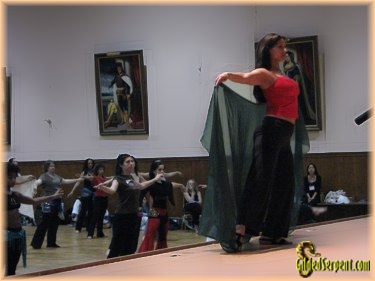
Feeling is an important part of what it’s all about for Randa. Her interpretations of songs come complete with full incorporation of the lyrics into her movements and gestures. For foreigners, watching her can be a good lesson in how important it is for an Egyptian audience to feel that the dancer is really understanding and ‘living’ the music. Since the days when I did my first interview with Randa, her life has opened up in many ways in terms of the dance. She has traveled to far flung corners of the globe – Chile, Argentina, South Korea, Singapore, Moscow, The United States, all over Europe – the list grows every month. Exhilarating, but also demanding. 'I know that people have appreciated me,' she says, 'and the travelling has really shown me that. It's been a lesson – and it's been very hard work! 'One of the dreams I've had at which I feel I've succeeded is in becoming a teacher. That's very important to me, because it enables me to pass on my passion for the dance to others.' A workshop with Randa gives dancers a taste of what it really means to discipline your body, to bring out of yourself strength you didn't know you had. But as well as demanding, she is also patient and full of humour. As well as knowing her professionally here in Cairo, I have had the privilege to go on tour with her, and get to know her on a more personal level, when we performed five shows around the United Kingdom in November 2006. Exacting in her professional persona, she is also fun – and my son Azz (four at the time) fell in love with her completely. As well as watching her avidly on stage, he also rushed backstage to 'help' as she changed costumes between sets, abandoned me on the tour bus, preferring to cuddle up with her instead – and then, the final straw, deserted me to sleep in her hotel room at night! What can I say, other than he was only one of many, both male and female, who succumbed to her charisma. Abroad Randa may be in total demand, but back home in Cairo, things haven't always gone as smoothly for her on the night-club circuit. Not only is there a dearth of decent venues for a performer of her caliber, she also has to contend with the notorious pitfalls of the dancers' profession.
Just as Randa refuses to play the role of the cabaret tease, she also unequivocally seeks work on her own merits as a dancer – and that's a tough road to follow, when not everyone else sticks to those principles. Also, unfortunately, whereas once dancers could become household names by appearing in movies and on TV, over the past couple of decades those opportunities have dwindled, with oriental dance all but disappeared from cinema and TV screens. I am bound to ask her, several years since our first interview, does she still feel unappreciated by Egyptians, and what steps would it be necessary to take for her to get more exposure in Egypt? 'Actually, I do feel more appreciated lately by Egyptians,' she says. 'Here on the Nile Maxime people come up to me afterwards and compliment me, saying they never realized that oriental dance could look like that! And in the past few years, I have received offers to appear in movies several times. But I've turned them down, for two reasons. First of all, because of my son, Karim. He is growing up (he's now 8) and I don't ever want him to have to listen to people talking about his mother in a derogatory way, because I'm a dancer. Then the film roles that I've been offered have unfortunately been frivolous, or portrayed the dancer in the stereotypical way they always do. The cinema has done enough to spoil the reputation of dancers, without me adding to it by taking such a role.
Despite the disappointments that continue to check her success in Cairo, Randa admits she feels best when dancing here on stage with her own orchestra. "Travelling is great from the teaching point of view, but obviously I don't get the same feeling dancing abroad with a CD as I do with live music. It's the power of the musicians playing live that gives me the true feeling to dance.' At home, and off stage, Randa is a mother, and a wife, and juggles all those elements of life that women do everywhere. She has bought a new home in a less crowded area of town, and enjoys spending time with her family. The future for her is bright. How can it not be for a person of such talent, passion and integrity? Have
a comment? Send us a
letter! Ready
for more? 10-17-07 A Report on the First International Bellydance Conference of Canada Part 2 - Saturday Gala Performance Photos by Denise Marino & Sussi Dorrell. Held at the Ryerson Theatre in Toronto Canada on April 21, 2007. Featuring international stars including Amir Thaleb and Randa Kamal 4-16-08 Journey
of Desire: A Foreign Dancer in Cairo, 2006, Review by
Catherine Barros 4-14-07 Randa
Kamal in Cairo The Photos of Susie Poulelis 12-18-06 My
Moment with Nagwa by Ahava 11-21-07Farida
Dance presents Cairo Nights: 2005 and 2006 DVDs reviewed
by Catherine Barros 8-4-08 My
Winning Experience at Leyla Jouvana and Roland's 1st
Bellydancer of the World Contest by Khalida 8-1-08 Fantasy
Bellydance, A New & Ancient Reality by Jehan 7-30-08 Ahlan
Wa Sahlan 2008, Not So Welcoming this Year by Yasmin |

 “My three favourite
singers to dance to (in terms of their music) are
“My three favourite
singers to dance to (in terms of their music) are  'Now if I was offered
a part as a dancer in which she is respected, and the dance
is respected – that would be different. Also, my real dream
is to dance in a theatre, and produce a real stage show with
oriental dance in it. Such an opportunity has been offered
to me before, but it involved investing a lot of my own money
– and I didn't feel quite ready to do that yet. Insh'allah
in future…'
'Now if I was offered
a part as a dancer in which she is respected, and the dance
is respected – that would be different. Also, my real dream
is to dance in a theatre, and produce a real stage show with
oriental dance in it. Such an opportunity has been offered
to me before, but it involved investing a lot of my own money
– and I didn't feel quite ready to do that yet. Insh'allah
in future…'


