|
Gilded
Serpent presents...
Leila
Haddad & the Gypsy Musicians of Upper Egypt
"In
the Trail of the Ghawazee"
March 2008 US Tour, sponsored by the World
Music Institute
by Amy Bonham
Franco-Tunisian
dancer and producer Leila Haddad has
been touring her full-length stage shows in Europe and
Asia for some time, but this year was the first time
she brought a full theatrical touring production for
the general public to the United States. Haddad, whose
influences are as diverse as Bert
Balladine and Sarah Petronio,
has been teaching and performing internationally for
several decades. Introduced to the American workshop
circuit by Balladine, she has been a popular teacher
of North African folkloric dances and raqs sharqi at
such festivals as the Rakkasah East
and West and Spirit
of the Tribes in Florida. Throughout
her career, she has fought for the acceptance of our
dance as a respected art form worthy of the best concert
stages.
Her
production of "Zikrayat", her choreographic
tribute to Egyptian singer Um
Khoulthoum, has appeared in Paris and Hong
Kong. This production, "On the Trail of the Ghawazee" has
toured extensively as well. The US tour was my first
opportunity to see one of her productions with live music.
Tour venues included large concert halls in New York
City; New Brunswick, New Jersey; Ann Arbor, Michigin;
Seattle, Washington; Washington, DC; and Los Angeles,
California. I attended the Los Angeles concert, the last
stop on the tour.
I
admit that I was a little apprehensive about her reception
going in. I’ve enjoyed her classes and performances for
years and certainly endorse her
mission, and as a result I was personally invested
in her success. It’s not that I had any doubts about
her artistry, rather the contrary. But in my experience
the preconceived notions of American audiences and critics
bring a great deal of negative cultural baggage to the
viewing of this art form. I had seen some reviews from
the first part of the tour, and one in particular made
me despair of ever reading a Western critic that can
accept our art on its own merits.
Claudia
La Rocco, a stringer
for the New York Times,
wrote:
"The
Tunisian dancer Leila Haddad must have fearsome abdominal
muscles. But it’s possible they are outstripped by
the muscles that kept a suggestive smile plastered
on her face for much of "In the Trail of the Ghawazee",
the 90-minute show she performed with the Gypsy Musicians
of Upper Egypt at the Skirball Center for the Performing
Arts on Thursday.” 1
The
reviewer plainly had no frame of reference for Middle
Eastern dance and was clearly uncomfortable with it and
the expression of emotion that is often missing from
classical Western dance.
The
tour was sponsored by the World Music Institute2,
a New York based non-profit dedicated to the dissemination
of music and dance from around the world. They produce
concerts in the New York metropolitan area and tour a
limited number of productions of the best of world music
and dance. Past acts have included Nusrat Fateh
Ali Khan, the Gypsy Caravan Tours
(I & II), and the Whirling
Dervishes of Syria, so this production
was joining a rarefied and prestigious tradition.
Six
master musicians from Upper Egypt accompanied the dancer
on this tour. Mohamed Mourad, Youssef Moubarak,
El Kinawy, Ramadan Atta, El Hamy Mohamed, and Abdallah
Farah were joined by Gamal Gomaa,
the popular Egyptian American percussionist who now resides
in Los Angeles. These musicians come from a long tradition
that could be as old as the pyramids.3
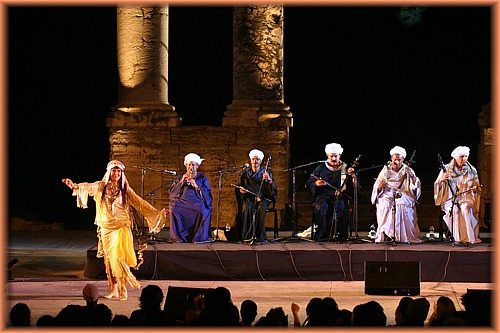
Musicians
listed in the program the night the author attended:
Mohamed Mourad, Youssef Moubarak, El Kinawy, Ramadan Atta, El Hamy Mohamed,
Abdallah Farah, Gamal Gomaa.
From Leila- photo " taken in the Antique Theater during the International
Arles Festival (South of France) with the Musicians
of the Nile (here we can
see only half of the musicians)"
|
I
believe that several members of the Haddad band, in particular
Mohamed Mourad, have played with "The Musicians
of the Nile" at various times. Many of these living
treasures are related and live near each other in the
environs of Luxor, and there seems to be a lot of crossover
among the musicians when they tour and perform. Haddad
has been working with musicians of this tradition and
presenting them in Europe and Asia since at least 1993.
It
is often written that the Egyptian Ghawazee probably
have roots in Roma migrations from Rajasthan in India.
I remember reading long ago about some interesting linguistic
clues in that regard. 4 Haddad’s
show was to trace the trail of those roots in dance and
music. I got the impression that this was not to be done
in the strict ethnographic sense, but rather as a thoroughly
researched homage to those cultures and a validation
of their art, so often mutated beyond recognition in
the West. I had some regrets about the constraints of
the theme leaving no logical place for her extensive
repertoire of folkloric dances from the Maghreb. But
those were immediately forgotten as the performers set
the stage for the beautiful tableau that followed.
The
musicians, dressed in turbans and galabeyas, were
seated on the stage on special folk-art benches brought
from Egypt. The gorgeous lighting, evocative of a desert
twilight, was the result, I learned later, of an eight-hour
lighting and tech rehearsal. The lighting was created
by Paris-based designer Patrick Riou,
who has had on ongoing association with Ballet
Preljocaj and has designed lighting for
the Paris Opera.
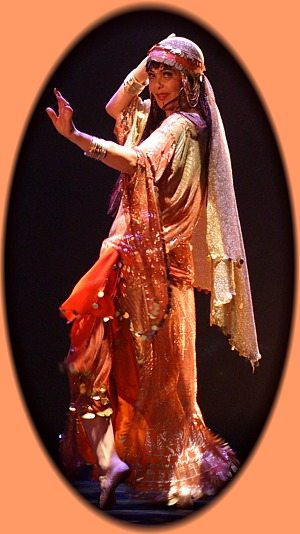
Haddad
came softly out onto the dimly lit stage carrying a lantern.
I’ve noticed previously that she knows how to claim her
space on the stage and draw the viewer in, and this was
a prime example of that skill. She slowly circled the
musicians to acknowledge them before setting down the
lantern and sitting with her back to the audience, rippling
her arms and fingers to a mystical flute taqsim. The
costume consisted of a red choli with vibrant yellow
and hot pink silky draperies and the tassels on the sleeves
moved with the music.
Starting
a performance by sitting down with your back to the
people takes a lot of confidence in the ability to
project and command attention from that angle. The
effect it had on me was to quiet me and cause me
to focus on every little finger ripple. The Kabelya
style of dance, as I understand it, is generally
subtle and refined, so this was a good strategy.
The whole tableau was magically reminiscent of nomads
resting by their campfire under a Thar desert sky.
 After
she rose, the music segued to a song with percussive
accents, and she floated across the stage leading with
one hip in a trajectory that choreographer-writer Doris
Humphrey referred to as the “path of power”,
the Via Triumphalis of choreographic blocking.
When the band broke into "Ghannili Shwaya",
her playful head slides and beaming smile got the audience
clapping with the drummers. I felt the infectious pull
of attraction to a beloved folk tradition grounded in
seamless stagecraft. After
she rose, the music segued to a song with percussive
accents, and she floated across the stage leading with
one hip in a trajectory that choreographer-writer Doris
Humphrey referred to as the “path of power”,
the Via Triumphalis of choreographic blocking.
When the band broke into "Ghannili Shwaya",
her playful head slides and beaming smile got the audience
clapping with the drummers. I felt the infectious pull
of attraction to a beloved folk tradition grounded in
seamless stagecraft.
The
next set began with the rababa and the mijwiz,
those quintessentially Upper Egyptian sounds. They set
up a call and response session with vocals from various
singers with the duff driving the numerous verses.
When Haddad joined them onstage after a costume change,
it seemed as if they had been irresistibly calling her
to appear. The golden discs on her bodice glittered,
surrounding her with dancing points of light, and the
flowing sleeves acted as an extension of her arm movements.
She wore an overbelt of wide hanging strips decorated
with shiny discs in the style of the Maazins circa
mid-70s that floated up and created a radiant whirlpool
as she spun. A rababa taqsim showcased tiny shimmies.
When the Saidi rhythm kicked in, the flirty dallae side
of her personality emerged. She danced with the singer
accompanied by sagat. The drummer knelt before
her and played to urge her on. I recognized some of the
signature Ghawazee footwork in which the foot
swings down from the knee with a gentle stomp. It was
delightful to hear the repertoire from the old recordings
in medley like that. “Habib ya dallae dallae”,
and was that “Bambi”? It was as though they were
having a relaxed conversation using music and movement
instead of words and were inviting us to be a part of
it.
A
long vocal interlude with rababa and riq set
up the next set, with two singers taking turns and riffing
off each other. In fact, most of the pieces began with
beautiful taqsims that showcased one or another
of the instruments or voices. Haddad made her entrance
in a black beaded melaya over a stunning red dress
of sheer material over tulle bi telli (also called assiute after
the region in Egypt). As she did some undulations at
the left side the stage, I reflected on another thing
that I’ve noticed about her in the past: that she makes
use of the entire stage, practically every inch of it
sometimes. This time her shimmies were mesmerizingly
extended and when the band shifted into a Saidi beat,
the audience went wild. The next song they sang to her
was apparently enumerating the dallae girl’s charms
and she responded to it with coquettish hand gestures,
miming showing off the beauty of her braids, hands, etc.
The fun and the sweetness of a teasing flirtation were
conveyed with joy. The riq player started teasing
her during “Salamat, salamat”, kneeling beside
her and trying to trick her with unexpected percussion
stops.
As
they cranked up the Saidi beat, one of the musicians
started handling his rababa like a tahtib,
brandishing it and playing it backward over his head.
Haddad and he gently leaned against the backs of each
other’s shoulders to dance together while he fiddled
above their heads. Then he turned and playfully brought
the rababa over her chest and bowed it there,
giving us a moment when it seemed like the music was
pouring from both of them. Wild spinning segued into
an extended percussion segment. Unlike the danced drum
solos you see so often these days, this one was relaxed,
which to me is characteristically Egyptian. It was exciting
and passionate, but not forced or busy. Airplane spins
spun her long braids free, and she dropped to the floor
for a dramatic hair-tossing zar-like segment.
 In
the final set the mizmars and tabl beledi began
a medley with a familiar song that had "ya aini,
ya aini" in the refrain. Haddad brought a shiny
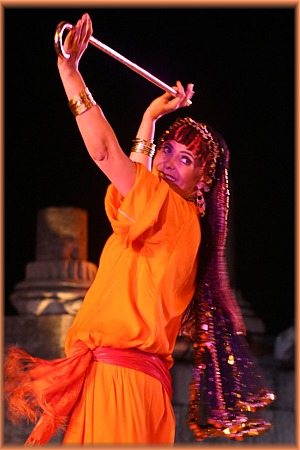
cane with her at her final entrance. She wore a red galabeya over
a full gold-trimmed skirt. A black glittery head wrap
was set off by large “Ghawazee-style” earrings.
She played off the musicians using timeless Upper Egyptian
folkloric cane dance movements. I doubt that much of
this interaction is scripted. These masters have been
working together for so long that they can be spontaneous
and go where the music takes them. I got the feeling
that the nuances of this music are as familiar to Haddad
as her own breath. When she balanced the cane on her
head and continued to dance, the mizmars went
berserk. She did a playful backbend over the tabl
beledi as the drummer played it, in the dance called "Asharat
al-Tabl". 5 The deep dum sound of that larger drum
upped the pace, driving the drama to its conclusion.
As the music came to a crescendo, she wrapped herself
up in her melaya, picked up her lantern and left
the stage. In
the final set the mizmars and tabl beledi began
a medley with a familiar song that had "ya aini,
ya aini" in the refrain. Haddad brought a shiny
cane with her at her final entrance. She wore a red galabeya over
a full gold-trimmed skirt. A black glittery head wrap
was set off by large “Ghawazee-style” earrings.
She played off the musicians using timeless Upper Egyptian
folkloric cane dance movements. I doubt that much of
this interaction is scripted. These masters have been
working together for so long that they can be spontaneous
and go where the music takes them. I got the feeling
that the nuances of this music are as familiar to Haddad
as her own breath. When she balanced the cane on her
head and continued to dance, the mizmars went
berserk. She did a playful backbend over the tabl
beledi as the drummer played it, in the dance called "Asharat
al-Tabl". 5 The deep dum sound of that larger drum
upped the pace, driving the drama to its conclusion.
As the music came to a crescendo, she wrapped herself
up in her melaya, picked up her lantern and left
the stage.
 The
show ran for over an hour-and-a-half without interruption,
which must have demanded a lot of stamina from a soloist.
It left me wanting more and from the size of the ovation
I deduced that I wasn't alone. The Egyptian proverb that
they printed in the program notes was an appropriate
coda to the concert. The
show ran for over an hour-and-a-half without interruption,
which must have demanded a lot of stamina from a soloist.
It left me wanting more and from the size of the ovation
I deduced that I wasn't alone. The Egyptian proverb that
they printed in the program notes was an appropriate
coda to the concert.
"Life
is like the Ghawazee, the Gypsy dancers from
Upper Egypt, who dance but an instant for each and
all."
After the show, the musicians were selling
Egyptian products to the exhilarated audience members
out in the lobby, including pretty crocheted beaded
scarves and their own instruments! The Los Angeles
dance community was out in full support. It occurred
to me how nice it would be to see some of them given
the opportunity to be staged with such professionalism.
Perhaps now that Haddad has opened the door a little
wider it will become easier.
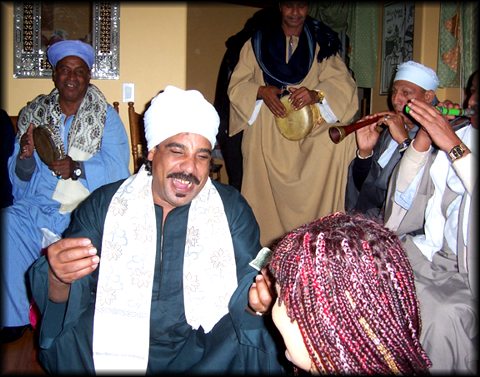
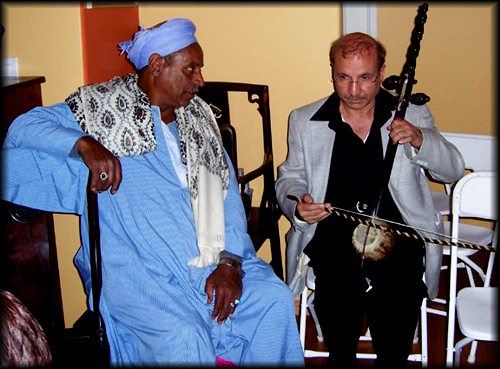
There
was an after-party for the performers hosted by a gracious
Egyptian ex-pat. It didn’t take long for the musicians
to start playing again. We felt fortunate to experience
Egyptian hospitality and see the Egyptian Americans
reveling in their music. The percussionists had not
brought their drums along, but they made do wonderfully
with what was on hand, including toys and tray tops
from the buffet. UCLA ethnomusicology professor Ali
Jihad Racy played along while wife Barbara,
another dance ethnologist, watched. And what a thrill
to see Aisha
Ali dance to the music that she was responsible
for introducing to the Western dance community years
ago. Her dancing is completely relaxed and free and
exudes a comfortable naturalness with the music; a
result, I’m sure, of lifelong friendships with these
artists and their music.
A
review of the concert was published in the Los Angeles
Times. Lewis Segal, at that time
the dance critic for the paper, wrote:
"Moving
across a darkened stage in layers of gleaming fabric,
she embodied all the glamour and fantasy that traveling
performers have brought to rural societies through
the ages – the escape from everyday life that we still
seek in nearly every kind of entertainment.
Some
people might call Haddad a belly dancer, but the term
would not only degrade what she performs by linking
it to cheap cabaret exhibitionism but also fail to
account for the amazing expansions and contractions
of the upper torso and chest that she displayed in
one solo or those liquid arms in her opening invocation
ritual or her intricate articulations of the neck.
...
Call
her instead a woman of the world, one who moved to
France in her teens but eventually defined herself
as an artist who belongs to many cultures and ages,
assimilating their beauties and sharing them with us
as our own world darkens and needs all the escape it
can get.” 6
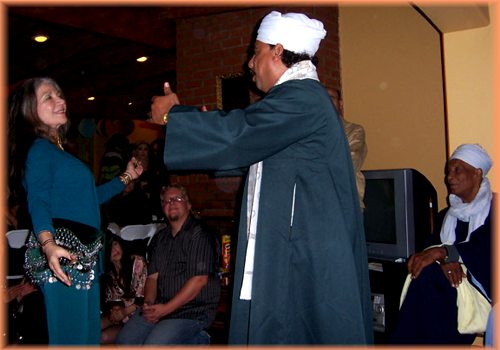
Aisha
Ali dances with E l Hamy Mohamed, one of the musicians
at the after party |
It’s
unfortunate that Segal’s job was a casualty of a recent
round of layoffs at the LA Times.
It would have been interesting to read any future reviews
of Middle Eastern dance forms. I found that this one
was at least informative and felt that it gave a sense
of what it was like to be in his seat in that theater.
I didn’t agree with some of it, notably a reference to
a "forced smile", but it was descriptive rather
than hostile. And the idea that the dancer can show with
his or her face what it is like to experience the movements
in the body is not presented often in ballet and other
Western dance genres.
The
review also gives us as a dance community fodder
for discussion regarding the "cheap cabaret
exhibitionism" comment. We shouldn't decry what
some might call journalistic misconceptions without
honestly scrutinizing what gives rise to them.
The
warm reception the world has given a concert presentation
of our art in the context of its genesis makes this an
opportune time to pursue some self-examination.
Notes & Resources
1 New
York Times review by Claudia La Rocco (May
require log in) -- This review is even more offensive than the quote intimates.
2 http://www.worldmusicinstitute.org/
3 Ethnomusicologists
Fumio Koizumi (Japan) and Hans Hickmann (Germany)
documented Egyptian folkloric music during the middle
of the 20th century, but the first recordings I ever
heard were done in the field by dance ethnographer
Aisha Ali around 1973-74. She performed with the
Maazin family of Ghawazee and recorded the
Abu Kherage band live on a boat on the Nile. Those
field recordings became the basis of the album Music
of the Ghawazee. Then in 1975
French ethnomusicologist Alain Weber became the director
of an Egyptian group called "The Musicians of
the Nile" (Les Musiciens du Nil) and
helped them to achieve success on the world music
circuit, including the WOMAD festival. They were
in the movie Latcho Drom which, somewhat like
this production, draws a thematic road through the
Gypsy traditions of various regions from India to
Spain.
4"Sirat-Al Ghawazee"-Part 1. Gilded
Serpent. 2005 by Edwina
Nearing
5As
described to Edwina Nearing by Ghawazee patriarch Yusef Maazin. "Sirat-Al Ghawazee"-Part 7. Gilded
Serpent. 2005.
6-
LA
Time review by Lewis Segal
|