


by Morocco/
Carolina Varga Dinicu In late 1960, I got my first job as an Oriental dancer. How? I was a Flamenco dancer with the Ballet Espanol Ximenez-Vargas & we were rehearsing at a Manhattan studio, owned by a Greek Orthodox priest, who was a friend. There was no pay for rehearsals & I was getting skinny. He told me he knew of a good dance job paying $125 a week, starting at nine thirty in the evening, so I could still rehearse with the company from noon to eight, get made up, work that job from 9:30pm - 4:00 am, go home, sleep, get up & go to rehearsal .... & have money to eat. Went with my guitarist to the Arabian Nights (unfortunately no longer in existence.) The owner looked at me, looked at my guitarist & asked "Who is this guy?" "My guitarist." She says "Well, we have a guitarist." Thinking
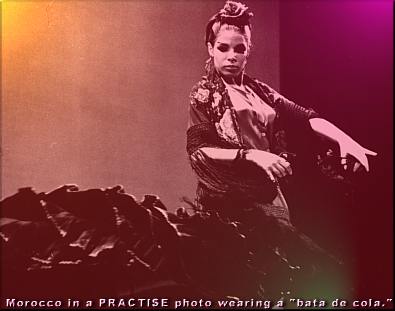
in terms of Flamenco, I ask "Does he know all the rhythms?" I change into my costume, called bata de cola in Spanish. It's the dress with the long, ruffled train, that all these very intense ladies kick around. I come upstairs & the owner asks, "What's that?" I'm thinking well, this is a restaurant. Maybe they don't like the costume because it would raise dust. I tell her that I have a short dress with polka dots or the riding habit.
Out comes this creature... I've been in the business over 42 years now & only twice have I seen anybody as bad as that woman. I looked at her & said, "If I can't do better than that, I'll hand in my feet!" A case of having more guts than brains. Another dancer, who overheard me said, "Oh yeah?!? Let's get you into a costume & see what you can do." She lent me her costume - I went out & slunk around from one end of the dance floor to the other. I thought I was hot stuff because I didn't fall on my behind. Nobody ran out. No one threw rotten eggs. They even threw money, which came as an extreme shock. I'd never seen that before either. The owner said "All right. You are a dancer. Not a Mideastern dancer, but you are a dancer. You have the job. For 2 weeks. You learn, you stay. You don't learn, thank you very much & good bye."
In proportion to the economy, dancers' pay was much better then than it is today & there were so many job openings, that if Godzilla had a costume, she could have gotten a well-paying & steady gig. There was a whole category of "dancers" we called the "Wonderful Walkers" - & they were. That's all they did: get out there & strut around the dance floor & twirl their veils, but, oh, how they did it! There were some truly charismatic & artistic dancers, there were the "smoldering sexpots", there were the novices, learning on the job & a few truly bad, awkward performers. This new audience of "civilians" came for the music, dance & excitement they saw in the film & went away having gotten even more than they'd hoped - including discovering & being fascinated with the Oriental dancers they saw there. There were none in the movie "Never on Sunday".
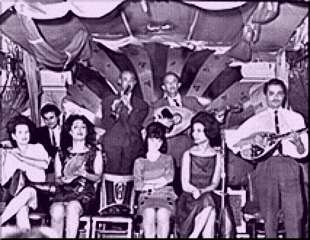
The Arabian Nights had 3 female singers: Lebanese, Greek & Turkish, all of whom danced during the taxims between the verses, in their formal dresses. From 9:30 pm to 4:00 am, when not changing into costume or doing one of our 2 shows each a night, we sat on stage, in our fancy, party-dress "civvies", with the musicians. To the delight of the other dancers in the clubs in which I performed, I saw it as a marvelous opportunity to learn all the tempos & countertempos & hogged the drum most of the night, banging away & bouncing around in my seat. We drank countless cups of Turkish coffee &, those who smoked, did - like chimneys. There were no anti-smoking laws for restaurants & night clubs then. Whole families came, from the great grandmas down to the newest baby, who usually slept under the table in a basket. Once, one family forgot the baby & had to come back! They came to listen to their music, eat their food & do their own dances. The homesick, who might never have gone to such places in their own countries, paid for special songs & cried when they danced to them. Men actually danced!: alone, with another man, in lines & circles - for their own pleasure. Something your typical American male would never do! (Ask me to tell you the hilarious story about my reaction the first time I saw a young Greek man do a solo zembekiko!) ** I watched it all & sponged
it up. When a movement one of the customers did caught my eye, I'd
wait till the (usually older) woman went to the ladies' room, follow, & convince
her to teach it to me then & there. At home, I tried all the
moves I saw the dancers do - often with hysterical
results. Fortunately, the Mambo, Merengue & Cha-cha arrived during
my early teen years, so at least I knew I had hips & that they
could be moved, but this was something else entirely! Thank heaven
there are no videos of what I was able to get away with calling "Oriental
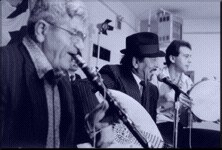
dance" in those days, while I learned on the job! Elderly musicians (many were in their 60s & older) & female customers, seeing that I was a "family girl" (meaning they never saw me smoke, drink alcohol or speak/go out with any of the male customers - the very strict, NYC Cabaret Laws** notwithstanding), extended their protection, advice, encouragement & continual, invaluable instruction & information about music, dance, lore, social custom, as it existed when they were young men & women & what they'd been told by their teachers, parents, grandparents, etc. These were people who took their ethnic heritage very seriously & with the greatest respect. Of course, some younger musicians made passes & when I refused, did some really "interesting" things to my music in revenge - which is why I can now dance to anything, in any tempo - when necessary. I also figured out how to get back at them - in a way that got their attention & respect.**
Our Oriental dances were improvised to live music for at least half an hour, often more, using what was considered the "expected" format at that time: fast opener/ magensi, slow/ rhumba-like tempo, heavy chifte telli or wahada kebira, drum solo & fast ending or fast Karsilama. Later, another upbeat section was added between the rhumba & the wahada or heavy Chifte Telli. We all used what we'd seen, learned & felt inspired to try. We learned to think on our dancing feet, since there was no guarantee as to who would play what nor when. My Flamenco & Latin dance gave me a love for & skill in executing complicated rhythms, countertempos, improvisation & soul. What I lacked then in technique, I made up for with warmth & enthusiasm - lots of enthusiasm!, so audiences took to me. I had a new "career"! No such thing as courses in Oriental dance, so it was on the job training. In spades. Of course, I made mistakes: most of them innocent, because I didn't yet know that some things, considered valid, beautiful dance steps by Western standards, were considered very vulgar & quite unesthetic by Eastern standards (ask me about my slooow Arabesque during the wahada & what Garabad the Oud player told me not to do & why!).**
I asked the musicians about this. They explained that some of these women really had come out of the Turkish "pavillions" or brothels, some had learned here by imitating them, but that I was to ignore those who did that style, as there will always be some who cater to the lowest common denominator. They told me to observe how the audience reacted to the different dancers. Trashy dancing got a loud, coarse reponse, while classy dancers were rewarded with attention, respect & admiration. Rote or bored looking dancers were ignored. They told me that I was definitely on the right track & they'd let me know if I did anything that didn't fit. They did, but always gently & with love. There were also truly marvelous & inspiring dancers to watch: to this day, I have never seen anyone do heavy Chifte Telli like Minee Coskun, or equal Saliha Tekneci's "attitude". The Algerian dancer, Badia, inspired the beginnings of my hipwork. I learned, bit by bit.
I was thoroughly enamoured & fascinated with the music & rhythms, the variety within one dance performance that was possible; more so, even than in Flamenco. I switched allegiances, but was subsequently to find out, through logic, linguistics, knowledge of history & in-person observation, that I had unknowingly gone back to the roots, the origins of Flamenco, which came from the Moors - the Moroccans, who ruled Andalucia for about 900 years - the very word "flamenco" came from Arabic: fella al mengu. The heelwork/ zapateo originated with the Moroccan Houara & the Rekza part of the Schikhatt. We won't even talk about the Zambra Mora right here! Also learned Greek, a bit of Lebanese Arabic & some Turkish by asking the singers what their songs meant, & my co-workers got a charge out of helping me acquire an even more interesting & useful vocabulary.. On my night off, I went to other clubs to see the other dancers, hear more music & dance for my own enjoyment, since as a customer, I could join in the line & circle folk dances & learn them, something forbidden to me where/ when I was working by NYC's Cabaret Laws of the time. I loved it & was totally bewildered when non-Mideasterners & other Flamenco dancer friends gave me major "attitude", when I told them what I was doing/ where I worked. Thanks to the American misnomer, the misconceptions that arose from it & those who chose to cater to the "harem fantasy" & lowest common denominator, it seems they thought I had gotten aboard that handcart that was going straight to hell. Nothing I could say about how much fun it was, how great the music was or that it was family entertainment, a folk dance, fer chrissakes!, would change their minds. As a former academic, I realized that at the very least, it would take cultural & historical fact to begin to make a dent in their kneejerk misconceptions & change their negative attitudes.
If you had worked in New York's vanished "Greektown" & were liked, you had a fabulous extended family, there & wherever there were Mideastern & Mediterranean clubs in the US & Canada. If anybody in that family needed help, everyone: waiters, musicians, singers, dancers, owners gave what was needed, without question or expectation of payback. If you had an argument with a husband, wife, lover, everybody took a side, had an opinion & gave it. Three minutes after anything happened, everyone knew it. The stories I could tell .. like the time Inglesos & Kezban had a screaming fight at the Egyptian Gardens, & she reached into his mouth, pulled out his upper plate & skedaddled off to their hotel room, locking herself inside for 3 days, while he slept, minus his uppers, in his club... While almost everyone insisted that Raks Sharki/Oryantal Tansi, by whatever name, from whatever country was a true folk dance & an integral part of their culture, when done in proper/family settings, I was made aware that there were varying degrees of "opposition"/ reputation damage for a female that went along with doing the same very dances, but in costume, for money, in a public that contained men not in the immediate family.
Turks told me that there was, indeed a "Gobek Tansi" - a "belly dance", but it was a different dance: a comic folk dance that was done at weddings, where 2 men drew faces on their abdomens - a man's & a woman's - pulled their shirts up over their faces & pretended the "guy" was chasing the "girl" & trying to kiss her. They roll their abs a lot in this one. I've seen it several times over the ensuing years: it's great fun, but it sure as heck is not Raks Sharki/ Oryantal Tansi. Most, especially Moroccans, Algerians, Tunisians & Saudis, mentioned that some of the movements had a link to easing childbirth. (See "Bellydancing &Childbirth", Habibi:Vol 3 #2, 1976, Sexology, April, 1965 or my website -http://www.casbahdance.org - under "Articles") I'd learn more about this in Morocco in person in 1967. So: who/ which story was the correct one? Was there more than one answer? How could I find out? That door would begin to open in 1963, again thanks to serendipity. Meanwhile, in
addition to my total immersion in the cultural milieu, I sought
every possible source of information. Carrying my
I understood that knowledge of clothing styles worn at various times, materials used, etc., could be very valuable in determining how one moved within or in spite of the garments worn. Were they the real garments of the area or were they imposed by religious fanatics or filthy-minded colonialists & missionaries? Were they ornamental or utilitarian? An indication of status, religion, ethnicity? A form of competition? Were there tattoos? For what, on whom, when & where? If there were any, what kind & where were they placed? What were the socially acceptable methods of flirting or was one supposed to look shy? Haughty? How far could one go in a particular dance? Did one acknowledge the audience or ignore it? The list is endless - as were the answers, which depended on era & area. . . . ** we will
try to find more about these stories in August when Morocco comes
back from her current tour! Have
a comment? Send us
a letter! Ready
for More? 5-13-03 Dancing
with Shelties by Justine Merrill 5-13-03 Fusion
Category added to Belly Dancer of the Universe Competition by
Luna 5-9-03 Kayla's
Travel Journal Continues--Hamam III by Kayla Summers |
 The
Gilded Serpent presents...
The
Gilded Serpent presents...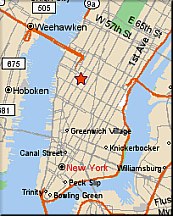
 The
1960s were a special time in New York: 8th Avenue,
from 27th to 29th Streets, had 10 restaurant/
night clubs with continual live, nightly Mideastern music,
3 dancers 6 nights a week, & a 4th on the 3 days the
others were off. That's 40 dancers needed in a city that
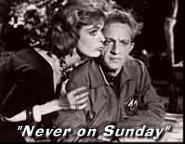
had maybe 10, who knew what they were doing. The hit movie "Never
On Sunday", starring Melina Mercouri as
a "happy hooker", set in the port of Piraeus, in Athens,
Greece, was the main reason there were so many successful,
crowded Mideastern clubs in New York at that time & so
much work for dancers of whatever degree of skill or lack
thereof: in that film, Americans "discovered" bouzoukia & were
flocking to the ones here in droves.
The
1960s were a special time in New York: 8th Avenue,
from 27th to 29th Streets, had 10 restaurant/
night clubs with continual live, nightly Mideastern music,
3 dancers 6 nights a week, & a 4th on the 3 days the
others were off. That's 40 dancers needed in a city that
had maybe 10, who knew what they were doing. The hit movie "Never
On Sunday", starring Melina Mercouri as
a "happy hooker", set in the port of Piraeus, in Athens,
Greece, was the main reason there were so many successful,
crowded Mideastern clubs in New York at that time & so
much work for dancers of whatever degree of skill or lack
thereof: in that film, Americans "discovered" bouzoukia & were
flocking to the ones here in droves. 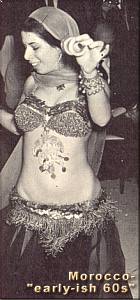




 The
older musicians & grandparents, who came to the club, were
the ones with the cultural knowledge I sought & they complained
that their own grandchildren were so busy becoming Americans, they
had no time for them & their stories about the "old country".
I had the time & wanted those stories, so I made friends with
a few of the grandmothers (let's hear it for the Ladies room!) & was
invited to their homes & family celebrations. I saw the culture
from the inside - over countless cups of Turkish/ Arabic/ Greek
coffee, in the kitchens & parlors, while the menfolk were at
work, & at frequent haflas, maharajans,kefs, glendis, church
socials, engagement parties & weddings for which I was hired
to dance. My obvious love & respect for them, their music,
dance & stories, plus my (to them) Mideastern looks made me
a welcome guest & gave entree to the women's culture, something
no male, even from the culture, had. On the other hand, since I
wasn't really "bint al balad", fortunately most
sex - based restrictions didn't apply: I had almost "honorary male" status.
Sadly, that wonderful world & best of "schools" is gone: those
children & grandchildren I mentioned did become American, moving
away from the old neighborhood & the music &
The
older musicians & grandparents, who came to the club, were
the ones with the cultural knowledge I sought & they complained
that their own grandchildren were so busy becoming Americans, they
had no time for them & their stories about the "old country".
I had the time & wanted those stories, so I made friends with
a few of the grandmothers (let's hear it for the Ladies room!) & was
invited to their homes & family celebrations. I saw the culture
from the inside - over countless cups of Turkish/ Arabic/ Greek
coffee, in the kitchens & parlors, while the menfolk were at
work, & at frequent haflas, maharajans,kefs, glendis, church
socials, engagement parties & weddings for which I was hired
to dance. My obvious love & respect for them, their music,
dance & stories, plus my (to them) Mideastern looks made me
a welcome guest & gave entree to the women's culture, something
no male, even from the culture, had. On the other hand, since I
wasn't really "bint al balad", fortunately most
sex - based restrictions didn't apply: I had almost "honorary male" status.
Sadly, that wonderful world & best of "schools" is gone: those
children & grandchildren I mentioned did become American, moving
away from the old neighborhood & the music &  dances
of their old - country parents.
dances
of their old - country parents.
 library
card, checkbook, eyes & ears wherever a printed or provable
fact could be found, bought, read, that would aid in my research,
notebook carefully concealed in pocket or purse, small change at
the ready for every passing xerox machine, fingers permanently
smeared with dust from rooting through thousands of old magazines
for pictures, buying prints, learning to distinguish which of the
Orientalist painters had really been there in person & which
had only been there in their overly-fevered racist/ erotic imaginations;
which of the writers were accurately describing what they saw & whose
opinions were greatly colored by colonialist assumptions or religious
fanaticism & hatred of any form of dance; which were colored
by Victorian hypocrisies & ignorance.
Which of these mostly foreign men got to see anything in
a normal household's women's quarters?
None.
library
card, checkbook, eyes & ears wherever a printed or provable
fact could be found, bought, read, that would aid in my research,
notebook carefully concealed in pocket or purse, small change at
the ready for every passing xerox machine, fingers permanently
smeared with dust from rooting through thousands of old magazines
for pictures, buying prints, learning to distinguish which of the
Orientalist painters had really been there in person & which
had only been there in their overly-fevered racist/ erotic imaginations;
which of the writers were accurately describing what they saw & whose
opinions were greatly colored by colonialist assumptions or religious
fanaticism & hatred of any form of dance; which were colored
by Victorian hypocrisies & ignorance.
Which of these mostly foreign men got to see anything in
a normal household's women's quarters?
None.  Which
photos had captions that reflected the condescending racism of
the times or were downright wrongly labelled? Where were the kernels
of truth in the muck of sensationalism? What is Ethnic dance anyway?
How can we tell if we are doing the "correct" thing?
Is there such a thing as "correct"? Does it change? How?
Why? How far can we go & still be "ethnic"? How much
room is there for creativity, or must it be rote imitation? What
kind of leeway is there in music? Dress? How can I tell if what
I'm being told or shown is correct? Who are the authorities? Are
they always correct? What are the criteria by which we judge all
this? Can we sit in judgement? Must one be a native? Can we believe
what we read? How much do personal tastes, morals & opinions
color so-called "historical accounts"?
Which
photos had captions that reflected the condescending racism of
the times or were downright wrongly labelled? Where were the kernels
of truth in the muck of sensationalism? What is Ethnic dance anyway?
How can we tell if we are doing the "correct" thing?
Is there such a thing as "correct"? Does it change? How?
Why? How far can we go & still be "ethnic"? How much
room is there for creativity, or must it be rote imitation? What
kind of leeway is there in music? Dress? How can I tell if what
I'm being told or shown is correct? Who are the authorities? Are
they always correct? What are the criteria by which we judge all
this? Can we sit in judgement? Must one be a native? Can we believe
what we read? How much do personal tastes, morals & opinions
color so-called "historical accounts"?  I
have a book, published in 1894, consisting entirely of photos of
the pavillions & personnel of the Chicago World's Fair
of 1893: the Columbian Trade Fair & Exhibition that
was supposed to have opened in 1892, but was .. a bit late. Some
of the photos are incorrectly captioned, some of those captions
insulting to the subjects depicted.
I
have a book, published in 1894, consisting entirely of photos of
the pavillions & personnel of the Chicago World's Fair
of 1893: the Columbian Trade Fair & Exhibition that
was supposed to have opened in 1892, but was .. a bit late. Some
of the photos are incorrectly captioned, some of those captions
insulting to the subjects depicted.  Because
they were brown-skinned & there was some sort of text with
pretensions of educating, it got by the censors & into homes.
The main thrust of the magazine was & still is the promotion
of "First World civilization" & its "White Man's Burden", its
bare-breasted "maidens" & "fierce warriors" deliberately depicting
non-Western cultures as "backwards", "childlike", "impulsive", "lascivious".
I suggest getting & reading "Veils & Daggers" by Linda
Steet & "The Colonial Harem" by Malek Alloula: they say what
I have been trying to get across for over 42 years & provide
pictures & foot-noted references. Just one example: the January
1914 National Geographic has Lehnert & Landrock photos
of the Ouled Nail taken at the close of the last century,
more than fifteen years before they were printed. In 1917 some
of these were reprinted, with different captions & hand-colored
with incorrect colors. Imagine a poor, innocent, novice researcher
coming upon the 1917 version! Some photos in the 1914 issue are
obviously contrived poses: Pp 11,15,40,41, just to mention a few.
Because
they were brown-skinned & there was some sort of text with
pretensions of educating, it got by the censors & into homes.
The main thrust of the magazine was & still is the promotion
of "First World civilization" & its "White Man's Burden", its
bare-breasted "maidens" & "fierce warriors" deliberately depicting
non-Western cultures as "backwards", "childlike", "impulsive", "lascivious".
I suggest getting & reading "Veils & Daggers" by Linda
Steet & "The Colonial Harem" by Malek Alloula: they say what
I have been trying to get across for over 42 years & provide
pictures & foot-noted references. Just one example: the January
1914 National Geographic has Lehnert & Landrock photos
of the Ouled Nail taken at the close of the last century,
more than fifteen years before they were printed. In 1917 some
of these were reprinted, with different captions & hand-colored
with incorrect colors. Imagine a poor, innocent, novice researcher
coming upon the 1917 version! Some photos in the 1914 issue are
obviously contrived poses: Pp 11,15,40,41, just to mention a few.


