Gilded
Serpent presents... Fitness gurus promote the current research-based wisdom that a balanced fitness program should include regular cardiovascular (aerobic) exercise, muscle strength and endurance training and flexibility training. Increasingly, experts recommend including a core strengthening component in our exercise programs. You’ve probably heard the terms neutral spine and core balance being bandied about, and seen numerous class offerings for Pilates, body ball, and core workouts. You may be wondering, is this the sort of thing you should be checking out? If any of your health and fitness goals include reducing back pain and strain, recovering from or avoiding low back injury, enhancing physical performance in sport and leisure activities, improving posture and feeling stronger and more centered, the answer is unequivocally, YES! Having good abdominal muscle fitness goes far beyond improving our looks and broadening our fashion options, although these are some of the fun side effects. Lack of core strength and stability, largely due to our sedentary lifestyles, is believed to be a major risk factor for lower back pain and injury. The incidence of low back pain in adults of all ages is pervasive and the cost to employers, health care and compensation systems is not insignificant. In Canada, low back pain is the cause of 21 million disability days annually and 80% of individuals suffer from low back pain at some point in their lifetimes. Incidences range in severity from temporary annoyance to complete debilitation. In the U.S. the annual cost of back pain related care and disability compensation is $50 billion. The term “core” refers to the muscles of the trunk that support the back and connect the ribcage to the pelvis and the pelvis to the legs. Good core strength and stability provides the capability to maintain a “neutral spine”— an ideal alignment between pelvis and upper trunk that distribute pressure evenly amongst the vertebrae and support structures and produces the least amount of mechanical stress on joints. In the neutral spine position, the lumbar vertebrae are stacked up nicely so that there is no excess curvature forward, backward or sideways, which can cause uneven pinching of the intervertebral discs and which can lead to disc bulging, wear and tear or even rupture. More often, a habitual non-neutral lumbar spinal curvature simply results in unnecessary back discomfort, muscle fatigue, and strain. Ergonomic design of work chairs and stations are designed to support and allow better spine position through external support, but they are no substitute for actual core strength. Unfit core muscles render us susceptible to injury from performing even the simplest tasks such as bending over to pick up a pencil. A huge amount of research has been and continues to be done on what kinds of stress the back can withstand and how much it takes to cause pain and injury. How strong is the human spine? This depends on whether what is being tested is the functional strength of an intact, living human, or just the bony vertebral column extracted from a cadaver. Whereas individual vertebrae can withstand loads of 900 to 2800 lbs of pressure before breaking, the extracted human spine with muscles removed will buckle under a compressive load of just 20 lbs! How can something so apparently flimsy withstand the kinds of forces a power lifter subjects his back to in routinely lifting loads of over 300 lbs?
This discrepancy between what the extracted and in vivo (living) skeletal spine can withstand underlines the importance of the role of muscles and ligaments to back stability and support strength. Muscles provide active stiffness through the control of the nervous system—greater activation equates to greater stiffness. Ligaments provide passive stiffness through their resistance to stretch. Increasing the stiffness of joints provides greater stability and functional strength. Injuries tend to weaken ligaments as well as produce abnormal coordination patterns amongst the muscles of the joint. Sedentary lifestyle may also result in reduced muscle coordination and strength due to disuse. Decreased strength/endurance and coordination both result in increased instability of the joint and an increased likelihood of injury or re-injury. Both prevention and injury rehabilitation strategies focus on retraining the muscle patterns that provide active support while enhancing muscular strength and endurance so support can be maintained. Balanced muscle activation is the key to lower back health and
stability.
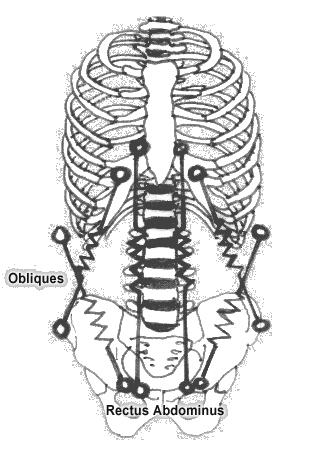
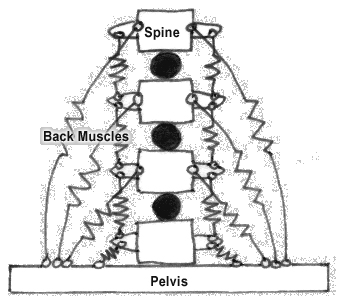
McGill believe that many back injuries result from a motor control error in which one muscle loses its stiffness and upsets the balance, allowing the spine to buckle, resulting in vertebral disc and endplate fractures, ligament and muscle damage, or disc rupture. Because the muscles that provide spinal stability must work together in harmony, it is not enough just to strengthen individual muscles. More importantly, they must be trained to work together to automatically maintain spinal support and stability during a wide range of activities. Also, the absolute strength of these muscles is less important than endurance, since they must be able to maintain activity throughout our daily and recreational activities. Which muscles do we need to train? Figures 1 and 2 show schematic drawings of the muscles of the abdominal wall and back respectively, which when activated together provide support and stability for the lower back. From this diagram you can easily see these muscles are “engineered” as a group to provide stability to the lumbar spine when they are activated together, creating even and balanced pull in connecting upper and lower trunk. Again, they don’t have to work at 100% to greatly increase stability—10% of their maximum is considered about right. The relative contribution of each muscle to stability depends on the dynamically changing nature of movement demands such as body position, amount of weight lifted, balance and range of motion required. As McGill says, “sufficient stability is a moving target”. During physical activity there is a conflict between breathing and stability; however, fit muscles are able to meet the dual demands whereas unfit muscles and poorly coordinated muscle groups are not. Pilates addresses this issue by training challenging breathing patterns while maintaining support. Core strength training begins with learning to isolate the individual muscles while lying down, progressing to maintaining coordinated activation of all (i.e. neutral spine) during a variety of positions and functional activities, such as bending over, picking things up, performing weight training or sports movements. The effectiveness (and safety!) of both of these training methods will depend largely on the competence of the instructor. Find out their credentials—a weekend certification course is insufficient training. They should have basic knowledge in fitness, biomechanics and be certified by a recognized organization. Which exercises are best?
McGill recommends that the best combination of exercises to ensure sufficient strengthening of the abdominal muscles are the traditional half trunk curl and cross curl up in bent knee position for the rectus, plus side bridges for the obliques. Back extension exercises to strengthen the muscles along the spine, can be done lying on a ball the feet braced against a wall. Core strengthening exercises teach all these muscles to co-contract in a coordinated way to maintain trunk stability during movement. Experts generally agree that exercises which strongly activate the psoas muscles (hip flexors) should be avoided by all but very fit individuals who require more challenging sport-specific training, since these muscles cause large compressive loads on the lumbar spine but don’t contribute to back stability. Consequently, the general population and especially those recovering from low back injury should avoid straight leg raises and full sit ups, since these exercises emphasize psoas activity but don’t strongly activate the abdominal muscles specifically involved in core strength and stability. To find out the state of your core strength and balance, and your possible injury risk due to being imbalanced and/or weak, get tested by a certified fitness consultant in your area (many fitness centres and gyms employ then). Once you’ve learned core strength exercises you can easily practice them at home several times a week to develop and maintain core strength and stability. Benefits include improved posture and appearance (you’ll be able to stand taller and reshape your waist without even losing weight!) improved performance in sports, dance and daily activities, improved energy level (gravity can’t weigh you down as much when you are standing straighter), decreased back muscle and joint pain, and decreased risk of injury. References:
Have
a comment? Send us a
letter! Ready
for more? 5-3-08 Improving
Breathing for Better Dance Performance by Taaj 10-30-08 Aussie
ATS Charm in Taipei: Devi Mamak by Lisa Chen 10-23-08 One
Dancer, A Journey of Self- Acceptance by Melodi 10-14-08 Inside
Peek at Making Music Videos: Hakim, Khalid Selim, Walid
Toufic, Ali el Hagar, Elam, & Samira Said by
Leila 10-8-08 Dance
- Deeper than the Moves by Keti Sharif 10-6-08 "Just
feel the music when you're on stage!”Interview
with Ozgen, Male Turkish Belly Dancer, by Nini
Baseema 10-2-08 Self-Esteem
and the Bellydancer by Taaj
|