


|
In keeping with the theme of this issue, I’m going to write about beauty this time. For me, a person who doesn’t see very well, beauty reaches me mainly through my ears rather than through my eyes. Beautiful music of course. I’d like to share some personal notes about my musical evolution in hopes that some new doors to beauty might open up for you. I call music beautiful when it touches off my deeper feelings and fantasies. We all have a wide variety of such feelings and fantasies and we can all be touched by many different kinds of music. In high school, it was the power and rejoicing of Handel’s Halleluia Chorus and the Battle Hymn of the Republic. In college, it was the romance in Green Dolphin Street as performed by George Shearing and Nancy Wilson; the gripping melancholy of the Concerto de Aranque by Joaquin Rodrigo; the boundless energy and excitement of Beethoven. Then there was and still is for me Jazz – much beauty. Somewhere in there a joyous gospel song slipped in and held me prisoner for a long time – the Edwin Hawkins Singers and Oh, Happy Day.
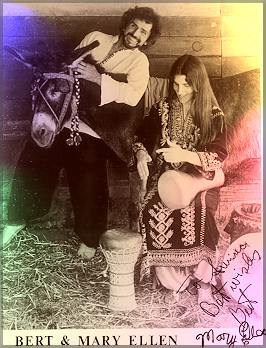
How to share my journey from Middle Eastern folk to Egyptian urban music? Several years ago after drumming for a show – “Mary Ellen, that music you and your musician friends are playing sounds like rock and roll or, better yet, square dance music” – loving commentary from my favorite critic, my husband, Ed. At that time I was playing some of the millions of songs that are in the baladi rhythm all the way through with a half a dozen verses and choruses all sounding the same. Yes, these were folk tunes, whose popularity was based simply on their familiarity. At that time, I liked those good old standard songs with their earthy sound and continuous steady driving rhythm. From time to time someone would introduce me to a new record with more of an Arabic urban flavor. I would listen to it once, conclude that it was good music to iron by (that’s a joke) or good background music for a Middle Eastern dress-up party – but for dancing to or learning how to play the drum, it didn’t do a thing for me.
The door really swung open on Saturday, October 8, 1977. I was teaching at a seminar with Bert Balladine for Patrima and Bob Margrave in the Washington, D.C. area. Five minutes into the rehearsal for our show, I was a convert. I was invited to join the band on tambourine – an outstanding band with Steve Ballajia, musical director on doumbec; Sayed Anany on tambourine, bongos and mazhar; Mahmoud Hassanan “Totto” on nay and mizmar (all from Washington, D.C.); Sammy Ansary on organ; and Hamouda Ali on violin (both from New York). The sound system was excellent so the good music came across powerfully. Many of the songs we played had a wide variety of rhythmical changes and breaks. I must say that rehearsal was a crash course for me.
I did all this because those sudden shifts in rhythm and tempo and the abrupt breaks in the music that were unfamiliar to me could have made me look like a fool – I making a beautiful stroke when everyone else was silent. (Needless to say, you as a dancer run the same risk of embarrassment when you perform to music that is unfamiliar.) That night the combination of beautiful Egyptian music, dynamic performance of Emar Gemal, Dalilah, and Patrima and Bert, and the exuberant audience made me pleasantly crazy and I think I still am.
Omar Khorshid playing guitar on his Tribute to Oum Koulsoum opened the door for me to the heavier orchestrated original recordings by Oum Koulsoum, the most renowned Arabic female vocalist of all time. Alf Leyla with its powerful violin sections and dramatic melody and rhythmical shifts is my favorite of Oum Koulsoum, with Leilet Hob also high on my list. With my discovery of Egyptian musical treasures I feel like I used to as a teenager listening to Elvis’ Love Me Tender for hours on end. It’s that bad. My friend Natasha from Chicago tells me I’m suffering from a common addiction known to the bellydance world.
My hope is that you will always be open to the beauty of music and that sometimes your beauty and mind will be the same. Have
a comment? Send us a
letter! Ready
for more? 6-2-06
Tribal Fest 2006, May 19
in Sebastopol photos by Susie Poulelis 6-1-06
I Love Lucy: Confessions of a Dancer
by Yosifah Rose 5-30-06
Fresh Old Sounds by Charmaine
Ortega Getz 5-29-06
Traveling to Tizi Ouzou by Linda
Grondahl |
 Gilded
Serpent presents...
Gilded
Serpent presents... Maybe
more important than all of this that I have found that being touched
by the beauty of music allows for a special kind of sharing between
myself and others whom music so moves. Such sharing comes
as a welcome relief after hours spent in individual strivings.
You and I have been so moved by different kinds of Western music
for years. So it’s not surprising that Middle Eastern music
has cast its spell on us.
Maybe
more important than all of this that I have found that being touched
by the beauty of music allows for a special kind of sharing between
myself and others whom music so moves. Such sharing comes
as a welcome relief after hours spent in individual strivings.
You and I have been so moved by different kinds of Western music
for years. So it’s not surprising that Middle Eastern music
has cast its spell on us.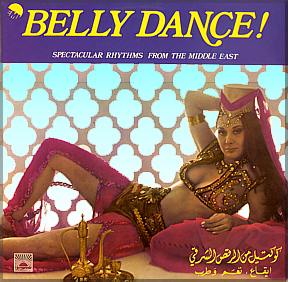 a
record for which he had paid twelve dollars in Morocco and guarded
with his life all the way back to the States – only to find that
the record was already popular with Bay Area dancers and selling
for seven dollars at Samiramis Imports. That treasure was
Belly Dance, Spectacular Rhythms of the Middle East with
the Rahbani brothers. Organ and drum, accordion
and drum. Where was the oud? Where was the saz?
That heavy baladi going into all kinds of 4/4 variations that
were fascinating. Exciting and definitely not to iron by.
The door to beauty opening slightly. Not too long after
that, I was nudged a little further by the words of my Arabic
music freak friend, Khadija: “Mary Ellen, you
play the drum pretty well. Why don’t you learn some decent
music?”
a
record for which he had paid twelve dollars in Morocco and guarded
with his life all the way back to the States – only to find that
the record was already popular with Bay Area dancers and selling
for seven dollars at Samiramis Imports. That treasure was
Belly Dance, Spectacular Rhythms of the Middle East with
the Rahbani brothers. Organ and drum, accordion
and drum. Where was the oud? Where was the saz?
That heavy baladi going into all kinds of 4/4 variations that
were fascinating. Exciting and definitely not to iron by.
The door to beauty opening slightly. Not too long after
that, I was nudged a little further by the words of my Arabic
music freak friend, Khadija: “Mary Ellen, you
play the drum pretty well. Why don’t you learn some decent
music?”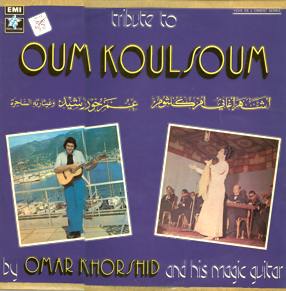 The
number of records in my collection doubled in three months with Middle
Eastern music with organ, accordion, trumpet, saxophone, guitar,
and moog synthesizer. Records that were just collecting
dust now played every day. Music of Mohammed Abdel
Wahab, Oum Koulsoum, Farid el
Atrache, Abdel Halim Hafez, and Omar
Khorshid. Heavy, heavy percussion with pleasing
combinations of American, Latin, and Arabic flavors.
The
number of records in my collection doubled in three months with Middle
Eastern music with organ, accordion, trumpet, saxophone, guitar,
and moog synthesizer. Records that were just collecting
dust now played every day. Music of Mohammed Abdel
Wahab, Oum Koulsoum, Farid el
Atrache, Abdel Halim Hafez, and Omar
Khorshid. Heavy, heavy percussion with pleasing
combinations of American, Latin, and Arabic flavors. 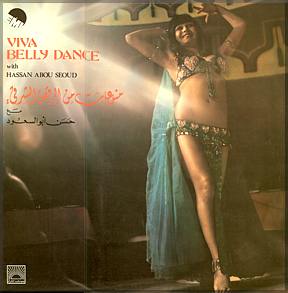 I’d
like to finish by sharing my most current musical turn-on.
Because I’m playing it so much, my husband has threatened to put
me out on the road for a really long trip. It’s an album
called Viva Bellydance by Hassan Abou Seoud.
The particular song which does me in is called Enousa.
I’d
like to finish by sharing my most current musical turn-on.
Because I’m playing it so much, my husband has threatened to put
me out on the road for a really long trip. It’s an album
called Viva Bellydance by Hassan Abou Seoud.
The particular song which does me in is called Enousa.


