Sheikka Rimitti Queen of the Rai by Linda Grondahl On May l5
in Paris, Sheikka Rimitti died at the age of
83. She was born in
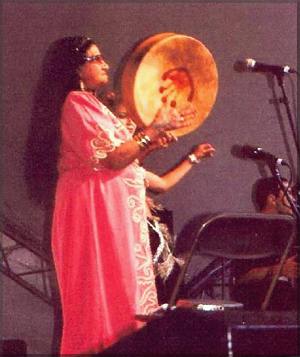
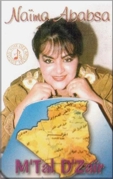
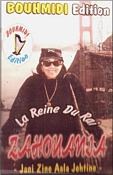
Rai means "opinion" in Arabic. To Algerians it also evokes the idea of freedom of opinion and advice. Modern rai evolved through the experiences of the Algerian musicians who were living in France based on the older rai traditions that formed in the coastal urban seaport of Oran. Unlike most of the music that we are familiar with from the Middle East that are usually unrequited love songs or patriotic love of country songs, the rai songs are about drinking, suicide, suffering, colonialism, poverty, exile, homesickness, corruption and the passion and pain of actual love making. The paradox of this music is that when Algerians hear these songs they sing along and dance and laugh and seem to be happy just to hear the songs. I'll never forget the first time I went to a Rai concert in Berkeley starring Cheb Nasro. Some young guys were smiling, laughing and dancing in the aisles and making slice movements on their wrists. I asked my husband what did that mean. He said, oh the song is about killing themselves because life is so hard. That was when I knew I wasn't in Egypt anymore! Sheikka Rimitti was an orphan and had a very difficult life. She was a popular wedding and nightclub singer in Algeria by the l940's. The French gave her the name "remettez" which means put it back or slang for give me another drink-something that she was always saying. Sheikka is an honorary title that was given to her later. (Other rai singers have the terms Cheb and Chebba meaning young guy or gal-Khaled was known as Cheb Khaled until he decided he was a little too old to be called young boy.) Remitti made her first recording in l952 and her last was just released this May. (She had been scheduled to perform at a big concert in Paris two weeks after her death). After Algerian independence in l962 the government banned her songs from radio and television In l976 she made a pilgrimage to Mecca and consequently gave up drinking and smoking at the age of 53. She did however continue to sing of the hard life. She emigrated to Paris in l978 but started visiting Algeria frequently after the new government rescinded the ban on her music. Many rai musicians "borrowed" or has she said "pinched" songs heavily from her repertoire. (she composed hundreds of songs). She continued to sing and perform through out the 80's but it wasn't until l994 when she was invited to perform at he Institue de Monde Arabe in Paris that the world music scene "discovered" her. Around that time she recorded Sidi Mansour with Frank Zappa's horn section and Robert Fripp from King Crimson and the bassist from the Red hot Chili Peppers. She also includes the traditional Algerian instruments, the gasba (wooden flute) and the darbouka (hand drum) which she plays with exceptional skill. On Sunday, July l4, 2002 she performed at Stanford University Amphitheater. I was so lucky to get to see her. At the age of 81 she sang, danced, and played the darbouka for over an hour. When her show was over it was announced that the next group had not arrived yet, so she continued on for another 30 minutes until the Tuva singers arrived (their plane had been late). Remitti has a deep, raspy voice that covers a wide range of notes and emotion and makes the audience understand what she is singing about even though it's in another language. She sings and dances of love, friendship, mourning, war, drinking, emigration and rebellion. I was also lucky to be able to go backstage and meet her personally because our friend Nasro was her last minute replacement keyboardist because the one who was supposed to come couldn't get a visa. (This was a persistant problem for artists from all over the world after 9/11). I received the traditional three kisses on the cheeks. A humorous side note to the Remitti story is that while my husband and I were visiting a very famous dancer in New York City (name withheld to protect the innocent/guilty), she wanted to play a CD for us to see if we knew what the singer's name was. She had gotten it from a friend and it had no photos or description of any kind. She said, I love this man, his voice is so romantic, so soulful. I know he is singing of love. I've been listening to him everynight since I got the CD. Well, we had to break the news to her, that she was in love with an 80 year old woman!!! Still, not believing me I had to send her a CD with her cover photo and pictures of Khal and me at the Remitti concert at Stanford.I have discovered that a great many of the popular male singers in Algeria sing in a higher range and that many of the popular woman singers are in the lower range. Two other female Algerian singers, Naima Ababssa and Zahuania ( I attended both of their concerts in San Francisco) had the lower singing range. On Warda's CD (originally from Algeria, she often uses the name Al Jaizeera , thus her name Rose of Algeria) that was released a few years ago, she sings in her usual Egyptian dialect. But on two songs she sings in Algerian dialect. Her voice drops and she has added the gasba an darbouka to the band. There is quite a bit of information on the Net about Remitti, Khaled, Rai music, Andalusian music and Algeria. I have purchased, but not yet read, the book The Social Significance of Rai, Men and Popular Music in Algeria, by Marc Schade-Poulsen written in l999. Aramco Magazine had a lenthly article on Rai a few years ago. Have
a comment? Send us a
letter! Ready
for more? 11-17-05
Traveling with the Touareg
by Linda Grondahl 6-29-06
“Gypsy” Dance in America,
by Caitlyn, photos of author by Rachel Ong 6-27-06
Om Kalthoum, The Voice of Egypt by
Yasmin
|