Gilded
Serpent presents...
Got
Strength?
Buffing up for Bellydance
by Aruna
One of the
reasons I love bellydance is that, unlike ballet or jazz, it’s
a dance most everyone can do. You don’t have to be born with a
certain body type, you don’t need to have started at age 6 and
it’s possible to do it for decades. Add the dress up part and
what’s not to love?
Most bellydancers
I know are in love with this dance. As in many a love affair,
however, it’s natural to expect it to fulfill too many of our
needs. What bellydance doesn’t supply in abundance, however, is
strength. While it certainly makes you stronger, there’s seldom
enough outside resistance to sufficiently strengthen muscles and
bones, unless you’re lifting a heavy prop or partner or doing
lots of floor work.
Muscles
are like smart-aleck teenagers. If you ask them to do something,
they do just enough to get the job done—and no more.
Muscles do
this as a survival technique, a hold-out from our cave days. Once
they figure out what’s required for a repetitive task, they recruit
the minimum amount of muscle fibers so they can save their big
energy expenditures for running away from danger. To coax the
body into continuing to progress and get stronger, you have to
surprise it: change your moves, the amount of time you do something,
the order of the movements or the intensity. Otherwise the muscles
virtually get bored and stop adapting! A sure way to keep muscles
firing, especially if you’re not getting any younger, is to add
strength training—at least that way you have more variables to
change.
Now
before you say “blech! That’s why I dance, so I don’t HAVE to
go to some smelly testosterone gym,”
you can do
the following exercises at home or in a studio. Many years of
teaching have shown me that these are the muscle groups both aspiring
and experienced bellydancers most need to give outside attention.
Of course, you shouldn’t do these or any exercises the same way
all the time, because, as I said above, the body adapts to any
routine and you get diminishing returns. But try mixing up your
approach and add these and other strength moves to your workouts!
Some
tips for bellydancers on getting your mind right around strength:
- Do
the exercises like a dance, slowly feeling your way through
each move. Take a minimum of 8 to 10 or more seconds
per rep—that’s rep, not exercise! With a set of 10 reps, that’s
over a minute and a half or more per exercise. For more fun,
go slower.
- Do
it to music that opens your sensual door.
- Consciously
connect to the muscles you’re supposed to be working. After
all, weight lifting is all about isolation—the same thing you
do when you dance.
- Maintain
a strong vertical axis (i.e. don’t lean sideways while lifting).
- Keep
a stable S curvature in both your lower and upper back (i.e.
slightly arch both).
- Avoid
any sharp nasty pain you might have from an old joint injury.
Don’t work through it. Work around it!
- Continue
until you’ve built a slow burning fire in the muscles—and if
possible do a little more by adding partial moves, change tempo.).
- As
for flexibility, do your longest deepest stretches after
your body is warm (not as a warm up) and hold each stretch for
10 to 30 seconds to make lasting improvements.
|
|
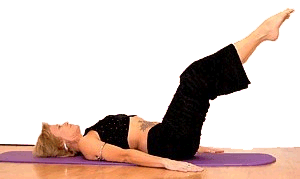
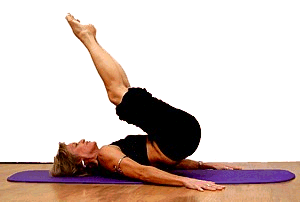
The
Abdominal Clock. This one move targets lower & upper
abs, lower back and obliques. Lie on your back with knees
slightly bent, toes pointed up to ceiling. You’re about to
tell time with your feet! Straight up is the mid-point of
your clock. Keep your lower back slightly arched at first,
knees aligned over hips, though your back will change shape
throughout the exercise. Just make sure you’re holding in
the lower ab muscles in every position and avoid losing control
of the torso muscles. Take toes to 6 o’clock, 3, 12 (overhead
with lower back lifted off floor), and 9 – several times slowly
around the clock face in either a diamond or circular shape.
The smaller the circle the easier it is. Reverse. Add ankle
weights for a bigger challenge. |
|
|
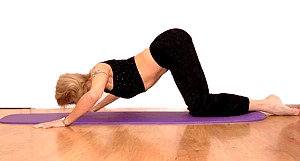
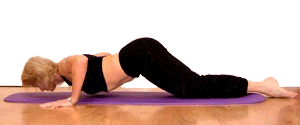
Slow Gooey Chadaranga
Pushup: There’s
no way to look sexy, proud or happy while dancing (or in
life!) with a sunken chest.
Yet
this is one of the most common mistakes beginning dancers
make. Besides using chest, this full body exercise also
uses triceps, shoulders, lats abs & lower back. As you
do this exercise, imagine you’re in the most lifted part
of a chest circle the whole time!
The
starting position: On hands and knees, press your shoulders
down toward your hips (the opposite of shrugging), slightly
arch your lower back and pull your navel up to your spine.
Slide your body weight forward and down, keeping the butt
slightly lifted. Circle your weight back and up, again keeping
butt lifted. Take care to maximize your chest work and minimize
shoulder involvement. For a good time, reverse. |
|
|
|
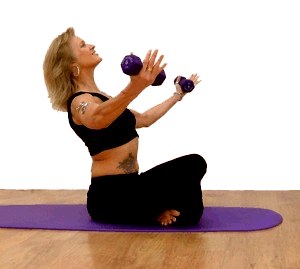
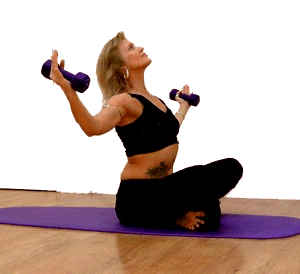
Chest
Circles, Lat Wings. More chest and lat work, yes, but
from a different angle. FYI, lats (latissimus dorsi) are
those big back muscles that run in a V shape from the shoulder
blades to your lower back. As a dancer, you need strong
contracted lats because they provide a bed for your shoulders
to sit on.
In
other words, with lat strength you can do snake arms for
a long time without your arms falling off!
Although
shoulders need to be strong for dance, it’s more important
to learn how to position the lats & chest to minimize
shoulder involvement (many of us have shoulder injuries
anyway!).
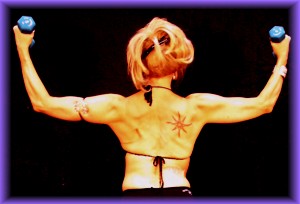
Using
light weights (from 3 to 7 lb. dumbbells), start with arms
in an A shape, shoulders down, chest lifted. Raise arms
slightly forward and up to a V shape, palms facing the ceiling,
keeping shoulders down (as if making a ritual offering to
the heavens). Lift the chest even more as you lower the
arms slightly behind you aiming elbows into your back pocket.
You
can apply this posture to your dancing: Lift your chest
and hold your shoulders down and back while you dance. Slightly
expand the lats outward while you dance (this isn’t dependent
on your breath) and allow your arm motions to connect to
your spine and not just the shoulders. |
|
|
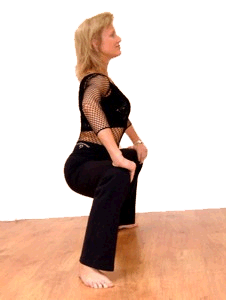
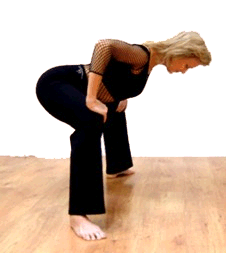
Deep
2nd Position Plie Quad & Butt Burner.
You can’t move hips with straight legs—but you can dance
for a long time and better, with your knees softly bent.
Although holding legs bent makes them stronger, deep plies
give you that extra strength you need to keep dancing longer.
Plus as you get older, with strong legs you can do level
changes in lunge positions rather than with the normal position
of feet together, heels lifted (a precarious position for
knees of any age).
Take
a wide stance with toes turned to 2 and 10 o’clock, ankles
over knees, hips directly under shoulders. Take several
slow, simple deep grande plies. When legs are sufficiently
warm, hinge torso forward from your hips, keeping lower
back arched, pressing knees open with elbows. Here’s the
fun part. Stay in deep plie with an arched back and hinge
torso back into an upright position. Most people can’t do
this without straightening legs a little. If you need to
straighten legs, go back into deep grande plie before calling
it quits and watch the steam rise off your thighs! |
|
|
Have
a comment? Send us a
letter!
Check the "Letters to the Editor"
for other possible viewpoints!
Ready
for more?
4-14-03 Act
Your Age? Notes from a Middle Aged Belly Dancer by Karen Andes
(Aruna)
But
sometimes, dancing near a gorgeous young dancer, I wonder how
long I’ll feel comfortable performing.
11-99
Adventures
of a Goddess (Part One) By Dhyanis
"...a
survivor of nightclub dancing - 5 years in Europe"
5-15-06
Rhythmical Truths Rhythm and
Reason Series, Article 11, by Mary Ellen Donald
In my books and in person, I make the point that there
are two basic kinds of rhythmical variations – embellishments
and fill-ins.
5-15-06
God Belly Danced, Part IV: The Rise of
the Pagan Anti-Belly Dance League by DeAnna Putman (Qan-Tuppim)
Dancing girls, wherever they came from, at this time
apparently were luxury import items and thus were subject to a
25 percent duty tax, equal to that of precious gems.
5-11-06
Rocking with Raqia by Taaj
Each explanation brought the class closer to understanding the
essence of Egyptian style.
|