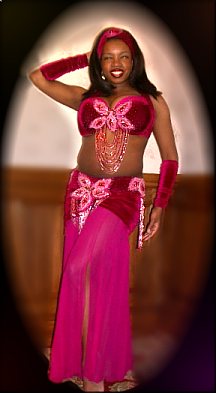
Making Wise Choices in the Belly-Dance Wear Market-place by Susi Costumes are a big part of our dance. We all love the visual feast of a fine dance in a sumptuous package, the glamour of dressing high-high up. A great costume can send a good show into greatness and almost make you forgive a poor one. An ugly or shabby costume can take the luster off a fine dancer. So how does one find a good costume amongst all the piles on vendors tables, amongst all the .jpg files on-line? Ten years ago, times were simpler. There were the big vendors and you traveled or waited for them to come to a hafla near you. There were a few knowledgeable seamstresses, usually other dancers who had a knack with a needle--or you made your own costume.
I'm also including costuming advice from Shadia Tohme Maalouf, who makes professional quality dance wear for working dancers: her costuming credits include creating dance wear for Dalia Carella, Nourhan Sharif, Katia, Azizza, Jehan Jamal, Ruby Jazayre as well as for ballet company productions such as Tony William's Urban Nutcracker.
What are your needs and how fat is your wallet? This is the first thing you want to determine. Are you a student preparing for a recital? Is this something you will wear once or twice? Are you not sure you will be belly-dancing for a long time? Are you in the process of losing weight and transforming your appearance? You will not want to spend a lot of money to look good. On the other hand, you don't want it to fall apart during rehearsal or worse yet the show. Are you bitten by the bug--you love to belly-dance--and think you'll be doing it until you become too arthritic to move? Is this a hobby that gives you much gratification with dressing up as part of the package? Then you may want to invest in something of higher quality. Are you starting to get work or already working? Costuming is a very important investment for your appearance. You want to cultivate a "look" all your own that enhances your unique way of moving. A costume helps define your on-stage persona. It's the first thing the audience sees when you enter, creating a visual first impression and a set of expectations for your performance.
As with most things, you get what you pay for. Costumes start at around $100- $150, which is a lot of money. But, think about it on an hourly rate. It takes about 40 hours minimum to construct and embellish a bedlah set. At $10 an hour that's $400 for labor which does not include the cost of materials. Materials will be at least $100 dollars, more if you have crystal and rhinestones. So, even at third world rates, $150 is not going to buy you much.
A quality costume--new--that is well constructed will cost you $500 and up. That seems to be the law. That is much cheaper than what we used to pay even 5 years ago. Competition has driven prices down. What you should be getting is well strung , heavy fringe, opulent bead-work, with a minimum of sequins used in the ornamentation as they lose color and bleed quickly, real glass beads as opposed to plastic, a well-constructed bra that can be taken apart with a minimum of fuss and fitted to you, heavy weight lycra for those slinky costumes, maybe even real silk in the skirt or veil.
The biggest mistake we see is in bras--dancers choose bras that are too big or small for their rib-cages. Straps can be moved or replaced, cups can be angled and padded, but the size and shape of the cup you have to live with. If you have a small ribcage and are slender it's hard to find bras that don't over whelm your upper body. Likewise large breasted women have trouble finding adequate coverage and wide straps for balance and support. The width of the hip belt cannot be altered but the diameter can be within reason. If it has overlapping more than a few inches, it'll look bulky on you. If it's more than a few inches too short, you'll need to invest in building it longer and matching the beadwork--which is possible--but when considering altering the diameter of a belt, always check the symmetry. Some belts can't go in or out past a certain point without appearing lop-sided.
Be sure you like your fringe - is the length right for your figure and does it enhance your dance style? Fringe is easy to change and embellish. Long fringe especially placed low on the skirt is great for Turkish style dancing and skirt work but Arabic style hip work needs fringe at the hip and short bouncy fringe looks great. Straight heavy fringe at the bottom of a bra is the least flattering arrangement possible- it cuts you into 2 halves visually. Drapes on a bra can slim the waist when placed properly and can be added later.
Think about what kind ornamentation you think looks best on you--you don't want to be over-powered by a costume. Ornamentation can be played with also. Another thing that is difficult to alter is the length of heavily ornamented dresses and skirts, especially the lycra ones. Some can be shortened but it is very time consuming, involving a lot of skill and patience. Lycra costumes need to fit snuggly. They can be taken in within reason. But there are limits to snug. Look at yourself in less than flattering light to see how much body texture you are revealing.
Pressed on sequin fabric looks fabulous but be aware that a skirt made from this fabric is almost completely transparent on stage or in strong light. We've seen entire troupes unwittingly exposing themselves in pressed sequin outfits! You need to make sure you check your skirts in the light--what seems opaque may not be as opaque as you think.
They look great for about a month but the finish rubs off and breaks down quickly with sweat and storage- that fabulous shiny skirt has de-nuded strips after 2 shows. Sparkly stretch velvets or pressed sequins wear much better. Start observing the costumes of other dancers and notice how the fabric wears over time before you invest a lot of money in a costume based on a coated spandex. It's a misconception that raks sharqi has to be performed in a two-piece costume. A cabaret dancer is obligated to wear one as a requirement of her venue but not all venues require a revealing look. This dance is traditionally done in a beledi dress or evening gown with a hip sash. A dress enhances the movements just as effectively as a bedlah and is much more flattering on some bodies than a bedlah.A lot of the shops do this willingly- the vendor measures you everywhere and writes the order up and you pay a deposit and send her the balance per her arrangements. You have to wait 6 months or so but you get a custom costume. There may be some variation in some minor materials--I had something made where the fringe beads were different on the original than on my costume but that is unavoidable--it still looked great and it fit like a glove. Some dancers with hard to fit figures really benefit from having their costumes custom designed. Dancers who want to cultivate a unique look can get a costume no one else has by having it made. A good costumer will know how to proportion the components of a costume to suit the individual and how to enhance assets and hide flaws in a creative way. Once you're looking at spending loads of money, it's a great option. Although custom work may cost slightly more than a high end mass produced Egyptian or Turkish costume it gives you a unique, well-fitting costume designed specifically for your stage personality and tastes. For some dancers it's well worth the expense and wait time to have their dance-wear made this way.
Don't wait until you need that costume for a gig. Get it when you see it if it's amazing or start having it made when the idea stirs you. And have fun--it's a buyer's market! Costumes shown in all photos designed, constructed or modified by Shadia Mirson Tohme of Boston. Have
a comment? Send us a
letter! Ready
for more? 12-26-04
Undercover Belly Dancer in Iraq- “THAAWUMPFF”
by Meena 12-23-04
We Shop, We Bathe, And We Eat! Justine’s
Culinary Adventures in Turkey, by Justine Merrill 12-9-05
New Dance Contest/Theme Party ”A
Night at Casablanca!” Photos by Lynette 12-16-04
Raven of the Night: Dancer’s Allegory
for New Year’s Eve 2005 by Najia Marlyz |