The
Gilded Serpent presents...
BELLYPALOOZA!
Goddess
Power
Comes to Baltimore
by
Elaine
"Take
my hand, I'm a stranger in Paradise."
In
one of those little quirks of "fate," I left Baltimore
45 years ago shortly
after performing as a harem dancer in a local performance
of "Kismet,"
(Turkish for fate) only to return again recently to be
surrounded by-harem
dancers! All shapes, all sizes, all ages and colors, joyfully
clad in hip scarves, leotards, sports bras, a rainbow of
tinted veils in hand, eager to join The Daughters of
Rhea in their annual BellyPalooza.
I
had made a reservation at Days Inn Inner Harbor on expedia.com
for a weekend
getaway to Baltimore, my hometown, to munch on crab cakes
at the
Cross Street Market, take a stroll through funky Fells Point
and enjoy the quiet ambience of Mt. Vernon Place. Shortly
thereafter, I came across an announcement for BellyPalooza
on the Internet. Rhea
and daughters Piper
and Melina would be holding a weekend of
dance seminars and a bazaar on the same weekend that I planned
my trip!
Rhea
had danced at the Greek
Taverna in the early '70s at around the same
time that I worked there as a cocktail waitress. Rhea was
always extremely
personable and a very exuberant performer. There were a
few really good dancers in North
Beach at the time, but Rhea was especially well respected
by the owners by virtue of the fact that she could really
grab an audience. She was a true entertainer. Who could
forget her dynamic entrances and bemused countenance, even
in the highly competitive atmosphere of Broadway in the
era of Bagdad
and Casbah,
Plaka Taverna
and the numerous clubs that dotted the San Francisco Bay
Area?
So,
having read of her wonderful adventures since that time-not
to mention
the impressive credentials of her two beautiful dancer-daughters,
Melina and Piper-I made a point of registering for BellyPalooza
right away. BellyPalooza comprised two full days of belly
dance seminars over the weekend of August 7th and 8th on
the Homewood campus of Johns Hopkins University. There
was also a scheduled performance at the Baltmore Museum
of Art the evening of Saturday, August 7th called "Belly
Dance Magic, an Evening with the Daughters of Rhea and Friends."
"Baubles,
bangles, hear how they ring, jing-a-ling-a."
Driving
down 95 from New York on Saturday, I anticipated what I
would buy
at the BellyPalooza bazaar. I had already ordered a fancy
pair of zills from Turkish Emporium, but my student veil
was over-dyed in an amateur attempt at tie-dying and in
pretty sad shape. I was anxious to buy something special,
if only as a memento of the event.
I
was blinded by the array of belly dance paraphernalia displayed,
from simple
cholis to dazzling costume jewelry and elaborate costumes.
Although I didn't find quite the right veil, I did find
a nifty hip scarf in black fringed chiffon with multi-colored
sequins that was perfect! I even tied the scarf over my
jeans while I continued to "window shop" the belly-wares,
lest anyone else snatch it up. The vendor, Lisanna,
was more gracious than most in not getting the least bit
uptight as I wandered the aisles in her hip-scarf.
"Not
since Ninevah, not since Tyre."
Lisanna
is with Salome's Tent, a belly dance supplier website, and
she was
kind enough to show me the various types of finger cymbals
she sold, even
though I explained that I had just purchased a deluxe pair
from Turkey. She
held each pair delicately and gently tapped them together
demonstrating the different tones they made. I liked the
silver "Tutankhamen" pair, which I eventually
ordered from her, along with a hot pink practice veil, a
nice medium weight and a very manageable 36" width.
Afterwards,
I was off to my old neighborhood of Fells Point for dinner
at Bertha's
on South Broadway, all the while wearing my pretty new hip
scarf. Baltimoreans are not particularly innovative (John
Waters aside) and everyone seemed fairly astounded by my
bold accessorizing. As usual, I eavesdropped on the conversations
at neighboring tables, which usually involved a woman asking
a man what he thinks of such-and-such. Very one-sided conversations,
these, which often sounded much like TV's Bill O'Reilly
espousing his ultra-conservative political point of view.
(Probably why
I left Baltimore in the first place.) Is it any wonder
that goddess-power
had finally taken root?
"Zubbediya, Zubbediya. Ishkaba-ya. Shabash!"
I
then rushed back to my hotel to change. I arrived in plenty
of time to
observe the local community of belly dancers and students
drawn to The Daughters of Rhea performance at Baltimore
Museum of Art. This was no jaded New York audience, but
an earnestly admiring group of women (and men) patiently
awaiting the star performers in contained but eager
anticipation.
The
first half of the two-part show consisted of performances
by Melina and
Piper in duet and solo performances, by Artemis,
a specialist in Turkish dance, and the student ensemble.
Melina and Piper, dancers most of their lives, are exceptional
performers. To me, the main difference in their styles
lies in how they use their energy. Piper demonstrates exquisite
control and technique-my feeling was that she somehow gathers
up her aura or energy and allows it to flow back to the
audience. Her sensitive performance of Fatamorgana,
"a dance of longing for a protected world filled with
childhood hopes and dreams" according to the dance
program, literally brought tears to my eyes.
Melina
seems to save her energy, revealing it in flourishes of
beautiful dancer's line and bold creative choices. In her
performance of Pom Pero Pero she appeared in flamenco
regalia, demonstrating the influences of Turkish Rom on
belly dance. It was hard to take my eyes away from her,
especially when she danced in golden angel wings in Of
Wings and Flame. The audience was truly amazed at
her trapeze performance with circus performer Sacha
Pavalata in the second act. A good reason to ration
one's energy!
Rhea
closed the first half of the show with a spectacular performance.
She entered
like a queen, wearing her years of cabaret experience in
gilded layers. After her usual lively entrance, she awed
the audience with her expert floor and sword work, rolling
the sharpened saber on her well-muscled belly to the audience's
delight. In closing, accompanied by two drummers, she demonstrated
her outstanding showmanship and unique ability to incorporate
humor into her performance without belittling her art.
Rhea
and daughters opened the second part of the show with two
traditional
Greek dances, the Hasapiko and the Zembekiko.
Years spent on the taverna scene, both in San Francisco
and Athens, were apparent. The taverna culture is warm
and familial, consisting of men drinking and dancing out
their joys and frustrations in a work-day world. Their
choice of music was very familiar to me. How many times
had I myself danced to Trio Bel Canto's melodic
version of Ta Dilina and Dionisiou's Paliazis,
back in the sparkling taverna days of North Beach! Needless
to say, I wished I could be up there with them.
The
aforementioned trapeze act with Sacha Pavlata was the big
surprise of
the evening. (The other surprise was the charming Hey
Mama danced by expectant mama Valarie,
a hip-hop belly dance that the audience really enjoyed.)
Melina also performs with Circus Flora, and the
sensuous trapeze act with Sacha was an unexpected treat.
The
program was interspersed with performances by the local
Daughters of
Rhea dance ensemble, including, flirty gypsy dances and
sleek cabaret dances, all demonstrating
the fine technique of teacher and choreographer Piper.
Both parts
of the show also were marked by Turkish style performances
by Artemis, who energetically demonstrated her expert repertoire
of Turkish cabaret, gypsy and folk dances. She is clearly
well versed in the art of Turkish dance and her performances
contributed greatly to the variety and professionalism of
"Belly Dance Magic."
One
of the main things I took away from BellyPalooza was that
belly dance
was not limited in music, dress, or venue. This ancient
art could successfully incorporate modern styles and music
while still getting the same feminine empowering message
across. It is also amazing that they managed to put in
two full days of dance classes along with the show. Beyond
that, I was impressed by the fact that these three women,
The Daughters of Rhea, in no way limit themselves. They
have successfully combined belly dance and professional
academic careers into full and enviable lives, following
the inspiration of mother Rhea. What an inspiration!
(Italicized
excerpts are from "Kismet", a Musical Arabian
Nights by Robert
Wright & George Forrest)
Photo captions are taken from the
program notes
|

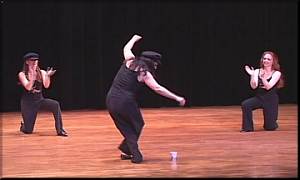
Hasapiko
performed by Rhea, Melina, & Piper
Developed over years of practice in smoky Athenian
tavernas. Most Greek folkdances are associated with outdoor
village life of a bygone era, but the Hasapiko evolved among
refugees in city tavernas and Rembtika clubs after the forced
exchange of populations between Greece and Turkey that occurred
as a result of the failed attempt by Greece to recapture
Constantinople in 1919. The Hasapiko is un-choreographed
and thus usually performed by small groups of friends who
can follow the leader by prearranged signals passed from
hand to shoulder. |