


|
When
Lynette Harris called the Dance
Brigade office and left a message for Krissy asking if she
had any articles or text discussing her thoughts on politics and
dance, I knew right away what to do. I returned Lynette’s
call myself and offered to interview Krissy on the subject. Since
I work for Krissy Keefer and am also a long-time
Gilded Serpent reader, I thought I would be in a unique position
to elicit her thoughts on dance, art and politics and share them
with the Middle Eastern Dance community.
KK: Well, I started dancing when I was a child, so I heavily identified with being a dancer from the time that I was six years old. In fact, my first ballet teacher told me that when I was six years old, I told her that I was going to be a ballerina. So whether to be a dancer or not was not a matter of choice for me. It was more about how was I going to integrate all of the things that were thrown at me, from being a young girl growing up in the fifties and sixties in Columbia, South Carolina, to being the eldest in a large family. I was in trouble a lot as a kid because I had a lot of energy. Concern for the underdog was always a big part of my makeup and something I learned from my mother; it could be translated now as a concern for justice. How to take all the parts of who I was and integrate them into my dance? It was kind of a natural thing that I became a political artist, because I burst into being as an adult at the time of the Vietnam war and the women’s movement and so I gravitated toward those causes. My sexual relationships with women were also integrated into the company that I started when I was twenty-one, the Wallflower Order, so all of those influences together created the “mosh pit,” so to speak, for the kind of dance that I would do. DL: So a political consciousness has always been a part of your dance life, because you grew up with this consciousness of the “underdog”, and your dance career and your sense of social justice evolved at the same time. KK:
Exactly! I had the unique opportunity of following
high school with three years of wandering around, figuring
out what I was going to do. Five years later, I was running
and being part of a dance company that would tour the
world in another five years. My career as a choreographer
and a performer with a very large and unique audience started
when I was 21 years old, which I believe is pretty unprecedented.
Most people mentor with someone for quite a long time and then
branch out on their own in their 30’s, but that was
not my experience. I was grasping at everything to find the materials
that would make up my dance while I was in a collective with
five other women in Eugene, Oregon. We started the Wallflower
Order. The genesis of my work was being part of an enormous
movement in the DL: It sounds like your work really captured the zeitgeist of the times you lived in, in terms of the women’s movement, political protest, civil rights, the growing awareness of third world cultures - all sorts of social issues.
DL: It’s just so unusual that you use dance as a vehicle for social change and social commentary. KK: Well, it’s not so unusual, since the politics of the female body are so enormous.
There’s a new book out about Martha Graham, Isadora Duncan, and Ruth St. Denis- they were very intellectually astute and smart about feminism, women, power, and mythology. They kind of set the stage, and their “palette” was very similar to mine. DL: And as women and artists, they were also very subversive for their time in terms of not following convention. Do you see yourself as part of a direct lineage from these foremothers of modern dance? KK: Yes, I do- although I didn’t have access to them at the time that I started out, because in 1975 it was really Merce Cunningham’s work that was the dominant modern dance motif. DL: Which was a very post-modern, abstract, formalistic aesthetic that was not content-driven. KK: So male! It’s about form and how form is put together. We rebelled against that because we felt it was boring. That’s kind of harsh to say, but for me Merce’s work was really boring, all those people moving all those different ways! I’m sure there is genius in it somewhere for somebody, but not for me.
So the question of how I took this form and did something really revolutionary with it comes as a result of this perception. I feel that dance as an art form has really suffered and that I have suffered from the perception of what dancers are, even within the women’s movement. “Oh, you dance?” It’s not quite as good as being a guitar player, or a folk singer, or a poet! DL: It must have been hard to hang onto your vision through all the decades of your work KK: Yes, except that we created an art form that has immense popular appeal. So many people want to see work that reflects their lives, so our audiences have always been enormous, hearty, and wildly enthusiastic. And we are good at what we do.
KK: I think the greatest art reflects the political realities of the time. The problem with all art is whether it’s good or not - that’s really what it’s about. Often political work is so specific to its time that perhaps it can’t be seen as a great work in thirty years, because it was too specific to its time. However, there are many poems, many paintings, many dances which endure because they have such artistic merit along with whatever their “statement” is. I think that if you look at any area of artistic endeavor, the greatest works are those that have something to say about the human condition. And what is the message of the human condition? Is it that we’re all really alienated, and that life is dark and meaningless, a la German existentialism, or it is it Mao’s revolutionary Red Detachment of Women, fighting the landowners, or is it the Bolshevik paintings - or is it Dance Brigade or Holly Near or Pete Seeger or Mark Morris’s new ballet, Sylvie, which has a feminist slant to it? Or rap - hip hop culture has changed the face of everything, and it’s about the experience of African-Americans trapped in the urban ghetto. Anybody who says that that is not happening, is completely out of touch with what’s going on. Even with the operas and the ballets, the ones that really get people are the ones that are like Dead Man Walking. Of course, there is really bad art, and really bad propaganda art - but I think the real intersection of the human condition and art is the oracle of the future. The oracle for the future. DL: This year, being an election year, has provided you with a unique opportunity to speak to the current post-9/11, wartime political climate. As a political artist, you have so much to work with! There is a sense of being in a dire situation on both the right and the left. Talk a little bit about the show you are working on right now.
DL: That sounds like so much more than a typical dance theater experience, it sounds more like Antonin Artaud’s idea of transformational theater. You are actually trying to give your audience an experience that they will fully engage in, as opposed to their just being spectators.
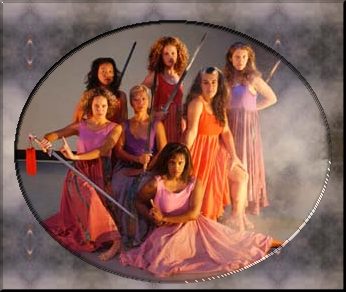
KK: I think I feel this very deep need to provide an opportunity for the community to come together at this point, because I feel like we are in very dire times right now. We take our ability to coalesce, to come together and ritualize, for granted as our birthright. Well, currently nothing is our birthright. Our constitution is in jeopardy, democracy is in jeopardy and everything is breaking down all around us, on every level. So let’s not take it for granted, but let us use every opportunity that we have to find community together through the arts. This is my offering. The character that I am playing is Hecate, the queen of the witches - she is about the breakdown of form, about decomposition, the rotting forest floor, the mushrooms, the compost pit, where form breaks down. Inside of this breakdown, the vision of the future starts to come out. Hecate is called the phosphorescent goddess, because out of the compost comes phosphorus, some kind of light. Things shift, and turn, and move, and her prophecy will be revealed. I am working with all of that imagery to create the piece. I am working with the dancers of Dance Brigade, Keith Hennessey and Circo Zero to do a whole piece outside, and Copper Wimmin are doing the music. We are creating the spell together. DL: How is it for you to journey into embodying this archetype, Hecate, queen of the witches, who obviously represents the wisdom and all-seeing of the crone figure?
I’ve always identified with that, with being a witch. I have partially transformed the myth into Tibetan Buddhism, because they have a strong witch culture through the Dakinis and dark goddesses - that iconography is all over the world. All cultures have the dark goddess. We need this now, more than ever, because it’s important for people to tell the truth. People like Amy Goodman, Helen Caldicott, Barbara Lee - anybody who is willing to say “this is wrong.” DL: And that’s what your art has always been about- telling the truth from your experience as a woman. KK:
Women have been burned at the stake as witches for telling
the truth. I have a book right now, called Against Forgetting,
of poetry written over the last 200 years by people who have witnessed
atrocities, in DL: That makes you very brave to be willing to do that. KK: Well, I’m scared now! I don’t know what is happening anymore. I know the Muslim community feels targeted, put in jail, accosted, separated out, made the “other” - the black community has been under siege for years, in economic injustice - people are still subject to being isolated, pushed out, incarcerated. That’s one more thing I want to say about the show. It’s really easy to get caught up in the darkness of the world right now, but Dance Brigade shows are exhilarating, and that’s why people come. They don’t come because the shows are dark and heavy, they come because they are funny; it’s enormously powerful to watch women playing drums; the dancers are stunningly beautiful, the costumes, the sets - everything has got so much magic in it that it is gripping and transforming, it changes the audience at the molecular level. That has to be there in order for the ideas to take seed - the shows are not just great politics, but they are alive with magic and possibility and really great art. Have
a comment? Send us a
letter! Ready
for more? 10-4-04
Folktour's
2nd Annual Music and Dance Camp Photos by Carl Miller, Report
by Mark Balahadia 4-11-03
An
Evening with Einstein's Daughters,
9-28-04
A Subjective View of Raqia's Cash
Cow The AWS Festival 2004, Part 1 by Andrea 8-4-02
Saturday
Night In San Francisco July 13, 2002 by Lynette Harris
9-25-04
The Ramzy World Tour of 2003,
photos provided by Hossam and Serena |
 Gilded
Serpent presents...
Gilded
Serpent presents...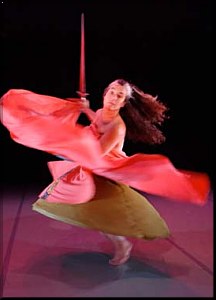 DL:
DL:
 KK:
Yes, we were very much a part of the times. I would
say that if I mentored with anybody energetically, I mentored
with Alvin
KK:
Yes, we were very much a part of the times. I would
say that if I mentored with anybody energetically, I mentored
with Alvin 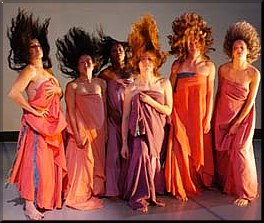 KK:
What’s happened for me around this election is that
I can’t actually go to a swing state and work for Kerry’s
campaign, but I feel that there are so many people in Northern
California that want to participate somehow, even though we know
our vote doesn’t really count. And I thought, well, what
KK:
What’s happened for me around this election is that
I can’t actually go to a swing state and work for Kerry’s
campaign, but I feel that there are so many people in Northern
California that want to participate somehow, even though we know
our vote doesn’t really count. And I thought, well, what


